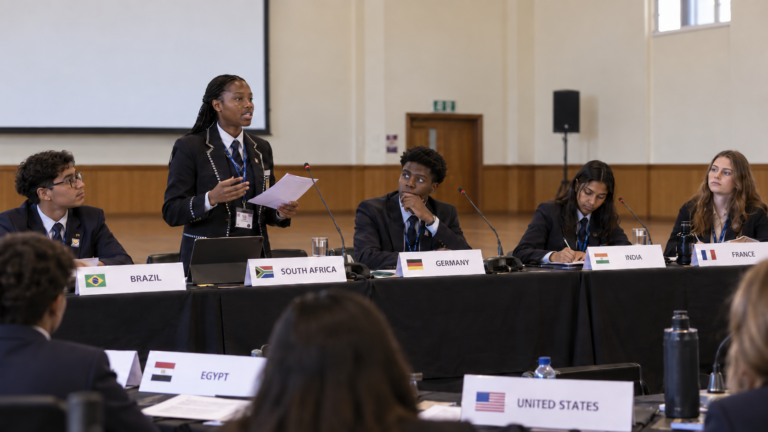
Imagine walking into a room filled with representatives from countries around the world. You have an important responsibility: to defend your country’s interests, debate a global challenge and work with other nations to find a solution.
That is exactly what you will experience at the upcoming EduFleek Johannesburg High School Model United Nations (MUN).
On Saturday, 17 October 2026, high school students will gather at SAHETI School, to discuss a topic that could shape their generation’s future:
“Establishing Global Rules for Artificial Intelligence: Balancing Innovation, Human Rights and Equal Access.”
Whether this is your first MUN conference or you have participated before, preparing properly will help you speak confidently, defend your country’s position and contribute meaningfully to the discussions.
This guide explains what you need to know, what to research, how to prepare your arguments and how to make the most of your MUN experience.
1. First, Understand What Model United Nations Is
Model United Nations is an educational simulation of the United Nations in which students take on the roles of diplomats representing different countries.
Your responsibility is not simply to express your personal opinion about Artificial Intelligence (AI).
You must represent the interests, policies and priorities of the country assigned to you.
For example, you might personally believe that AI should be strictly regulated. However, if your assigned country prioritises technological innovation and economic growth, you will need to understand and defend its actual approach.
During the conference, you will have opportunities to present arguments, listen to other countries, negotiate, build alliances and work towards a resolution.
The goal is not simply to win a debate. It is to help countries reach an agreement.
That means good preparation involves more than writing a speech. You must understand the issue, anticipate opposing arguments and develop realistic solutions.

2. Understand the Topic: Why Does the World Need Rules for Artificial Intelligence?
Artificial Intelligence is transforming how people live, study and work.
AI can assist doctors in diagnosing diseases, help students understand difficult subjects, support businesses and improve agricultural productivity.
However, it also creates significant challenges.
What happens when AI systems make unfair decisions? Who is responsible when AI-generated misinformation causes harm? Should technology companies be allowed to collect personal information without meaningful consent?
And perhaps most importantly, how can countries with fewer resources benefit from AI rather than falling further behind?
These are the questions that governments and international organisations are trying to address.
For your MUN preparation, concentrate on five important areas.
A. Innovation and Economic Development
AI has the potential to create new industries, improve productivity and support economic growth.
However, strict regulations could increase costs and make it more difficult for smaller companies to develop new technology.
Consider this question:
How can governments encourage AI innovation while ensuring that new technologies are developed responsibly?
Some countries may favour flexible regulations that encourage investment. Others may argue that stronger safeguards are necessary to prevent harm.
B. Human Rights and Privacy
AI systems may collect and analyse enormous amounts of personal information.
They can also produce biased outcomes that unfairly affect individuals or groups.
For example, an AI recruitment system could disadvantage certain applicants if it was trained on biased historical data.
Consider:
Should all countries agree on minimum human rights and privacy protections for AI systems?
Think about discrimination, data protection, freedom of expression and the right to privacy.
C. AI Safety, Deepfakes and Misinformation
Artificial Intelligence can generate realistic images, videos and audio recordings of events that never happened.
These are sometimes called deepfakes.
Such content can be used for entertainment and education, but it can also spread false information, damage reputations and facilitate fraud.
Consider:
Should governments require AI-generated content to be clearly identified, particularly when it could mislead the public?
You should also think about children’s safety and how AI systems should be tested before being introduced into sensitive areas such as healthcare or education.
D. Equal Access to Artificial Intelligence
Not every country has the same access to reliable electricity, high-speed internet, advanced computers, funding or skilled AI professionals.
Wealthier nations may be better positioned to develop and benefit from advanced AI technologies.
Developing countries could struggle to compete.
This is particularly relevant when discussing Africa’s technological future.
Consider:
How can the international community ensure that developing countries have meaningful opportunities to develop and use AI?
Possible solutions include international research partnerships, training programmes, digital infrastructure investment and access to affordable technology.
E. Accountability and International Cooperation
AI systems are often developed in one country and used in many others.
This creates difficult questions about responsibility.
If an AI system developed abroad causes harm, which laws should apply? Should responsibility fall on the developer, the company using the system or another party?
Consider:
Should countries develop shared international standards for AI, or should each government establish its own rules?
Remember that international cooperation does not automatically mean every country must adopt identical laws.
A successful agreement may establish shared principles while allowing countries to adapt their national approaches.

3. Research the Country You Have Been Assigned
This is one of the most important parts of your preparation.
Before the conference, you should understand how your assigned country views Artificial Intelligence and what it hopes to achieve.
Start by learning about its economy, level of technological development, political priorities and international relationships.
Then investigate its approach to AI.
Find answers to these questions:
Does your country have a national AI strategy, policy or relevant legislation?
Is it investing in AI development, research or education?
What concerns has its government raised about AI risks, privacy or safety?
How might AI affect its economy and employment?
Does the country support international cooperation on AI governance?
Which countries or international organisations might share its priorities?
What practical outcomes would your country want from a global AI agreement?
Important: Do not assume that all wealthy countries share the same position or that all developing countries have identical priorities.
Your arguments should be based on evidence of your assigned country’s actual policies wherever possible.
Where should you find information?
Start with official government websites, ministries responsible for technology and foreign affairs, and statements by your country’s representatives to the United Nations.
You can also consult international organisations, including the United Nations, UNESCO and the African Union.
Use credible reports and reliable news sources to understand recent developments.
If you use AI tools such as ChatGPT to assist your research, use them to explain complex ideas, organise notes and test your understanding. Always verify claims about government policies, laws and international agreements against trustworthy sources.
Never present an AI-generated statement as your country’s official position without checking it.
4. Understand What the International Community Has Already Done
You do not need to become an international law expert, but understanding existing AI governance efforts will make your arguments more persuasive.
Three developments are particularly useful for this conference.
The United Nations Global Digital Compact
In September 2024, world leaders adopted the Global Digital Compact as part of the Pact for the Future.
It provides a framework for international cooperation on digital technology, including Artificial Intelligence.
Its objectives include protecting human rights, reducing digital inequalities and strengthening international cooperation.
The United Nations has also established an Independent International Scientific Panel on AI and a Global Dialogue on AI Governance to support international discussions.
Why this matters: You can propose ways to strengthen or implement existing international commitments rather than assuming that global AI cooperation must begin from scratch.
UNESCO’s Recommendation on the Ethics of Artificial Intelligence
Adopted in 2021, this recommendation provides international guidance on ethical AI development and use.
It places particular emphasis on human rights, fairness, transparency and human dignity.
Why this matters: It provides principles that delegates can reference when proposing protections against discrimination, privacy violations and irresponsible AI use.
The African Union’s Continental AI Strategy
The African Union endorsed its Continental Artificial Intelligence Strategy in 2024.
The strategy promotes responsible, inclusive and development-focused AI while strengthening Africa’s ability to participate in the global AI economy.
Why this matters: Delegates representing African countries can investigate how regional priorities such as infrastructure, skills development, innovation and equitable access relate to their country’s position.
These frameworks provide valuable starting points, but they do not settle every question. Your role is to consider what should happen next.
5. Prepare a One-Page Country Position Brief
Once you have completed your research, organise your findings into a document you can consult quickly during the conference.
Your brief should include your country’s name, its key AI policies and its most important priorities.
Identify three positions you want to defend, two concerns your country would raise and two practical solutions it could support.
Also think about what your country might be willing to compromise on.
For example, your country might support international standards for AI safety but oppose rules that would make advanced technology unaffordable for local businesses.
This brief is your diplomatic reference document.
If the organisers request a formal position paper, follow their specific instructions for its length, format and submission deadline.
6. Prepare Your Opening Speech
Your opening speech is an opportunity to introduce your country, explain its priorities and demonstrate that you understand the topic.
Aim to prepare a speech of approximately 45–60 seconds, unless the organisers provide a different speaking limit.
An effective speech should explain the challenge, establish your country’s position and recommend a practical way forward.
Example Opening Speech
Honourable Chair and distinguished delegates,
The delegation of [Country] recognises that Artificial Intelligence presents significant opportunities for economic growth, education and technological development.
However, these opportunities must be balanced with the responsibility to protect human rights, ensure public safety and prevent inequality between nations.
Our delegation believes that international cooperation should focus on [your country’s main priority].
We therefore encourage Member States to consider [your proposed solution], while respecting the different economic circumstances and development priorities of individual nations.
We look forward to working with fellow delegates to develop a practical and inclusive global approach to Artificial Intelligence.
Thank you.
Remember: This is a speech structure, not an official country position. Replace the placeholders with arguments supported by your research.
Tips for Delivering Your Speech
Speak slowly and clearly. Maintain eye contact with the room rather than reading every word from your paper.
Practise aloud several times and time yourself.
You do not need complicated vocabulary to sound diplomatic. Clear, well-supported arguments are far more effective than long sentences filled with unfamiliar terminology.

7. Prepare Solutions, Not Just Arguments
One of the biggest differences between ordinary debating and MUN is that delegates are expected to work towards practical solutions.
It is easy to say that AI should be safe, fair and accessible.
The challenge is explaining how governments could achieve those goals.
Before the conference, prepare at least three proposals that align with your assigned country’s priorities.
For example, delegates might consider recommending international guidelines for testing high-risk AI systems, encouraging partnerships that improve AI education in developing countries or establishing standards for transparency when AI-generated content could mislead the public.
Ask yourself whether each proposal is realistic.
Who would implement it? Who would pay for it? How would progress be measured? Would other countries support it?
A proposal becomes much stronger when you can answer these questions.
8. Learn the Basics of Resolution Writing
A resolution is a formal document expressing the decisions or recommendations agreed upon by a committee.
During MUN, delegates may negotiate the wording of a draft resolution and propose changes before it is adopted.
Resolutions usually contain two types of clauses.
Preambulatory clauses explain the background, concerns and principles behind the proposed action. They often begin with words such as Recognising, Concerned or Recalling.
Operative clauses describe the action being proposed. They often begin with words such as Encourages, Recommends, Requests or Calls upon.
For example:
Preambulatory clause:
Recognising the importance of ensuring that developing countries can participate meaningfully in the development and use of Artificial Intelligence,
Operative clause:
Encourages Member States to establish voluntary international partnerships that support AI education, digital infrastructure development and technical training in developing countries.
This is only an illustrative example, but it demonstrates how a broad concern can become a practical proposal.
Remember that the specific resolution-writing process will depend on the rules and instructions provided by your conference organisers.
9. Practise Diplomatic Debate and Negotiation
You do not need to memorise hundreds of formal phrases to participate effectively in MUN.
However, learning a few expressions can help you communicate confidently.
When presenting your position, you might say:
“The delegation of [Country] believes that…”
When agreeing with another delegate:
“Our delegation supports this proposal because…”
When disagreeing respectfully:
“While we recognise the concerns raised by the delegate, our country takes a different position…”
When proposing cooperation:
“Would your delegation consider supporting a proposal that addresses both concerns?”
When seeking clarification:
“Could the distinguished delegate explain how this proposal would be implemented?”
Learn to Listen as Well as Speak
Strong delegates pay attention to what other countries are saying.
Take notes during speeches and identify possible areas of agreement.
If another country shares your position on privacy protection, you may be able to work together even if you disagree on other issues.
Negotiation requires flexibility.
You might not achieve every objective you initially wanted, but securing an agreement that advances your country’s priorities can still be a diplomatic success.

10. Understand How a MUN Conference Works
The exact programme and rules vary between conferences, so the EduFleek preparation materials and instructions from your Chair should always take priority.
Generally, MUN conferences involve formal statements, structured debate, opportunities for negotiation and the development of draft resolutions.
Click here to view the EduFleek Model United Nations Conference. Guidelines.
Do not worry if you are unfamiliar with MUN terminology.
The most important things are to follow the Chair’s instructions, participate respectfully and remain focused on the issue being discussed.
11. Anticipate Questions from Other Delegates
A useful way to prepare is to imagine the questions that other countries might ask about your proposals.
For example, if your country supports strict AI regulation, another delegate might ask:
“Could these regulations make it harder for developing countries to compete in the global AI economy?”
If your country supports expanding AI access, you might be asked:
“How would your proposal protect people’s privacy and prevent misuse?”
Prepare answers that acknowledge legitimate concerns while defending your country’s priorities.
You should also prepare questions of your own.
Good questions challenge the practicality, fairness or effectiveness of another country’s proposals without attacking the delegate personally.
If you do not know an answer, avoid inventing information. Acknowledge the question and refer to the evidence or principles you can confidently defend.
Advice for First-Time MUN Delegates
Your first MUN conference can feel intimidating, particularly if you are surrounded by students who seem more experienced.
However, experience is not the only thing that makes a good delegate.
Preparation, curiosity, respectful communication and a willingness to participate are equally important.
Do not spend the entire conference waiting for the perfect moment to speak.
Make a contribution, even if it is brief.
Ask a thoughtful question. Support a practical proposal. Introduce yourself to another delegation and explore an area of agreement.
Remember that diplomacy is not about speaking louder than everyone else.
It is about understanding different interests and helping people move towards a shared solution.
You may arrive feeling nervous, but each contribution will help build your confidence.
How to Register
If you haven’t yet registered, please click here to visit the conference information and registration page.