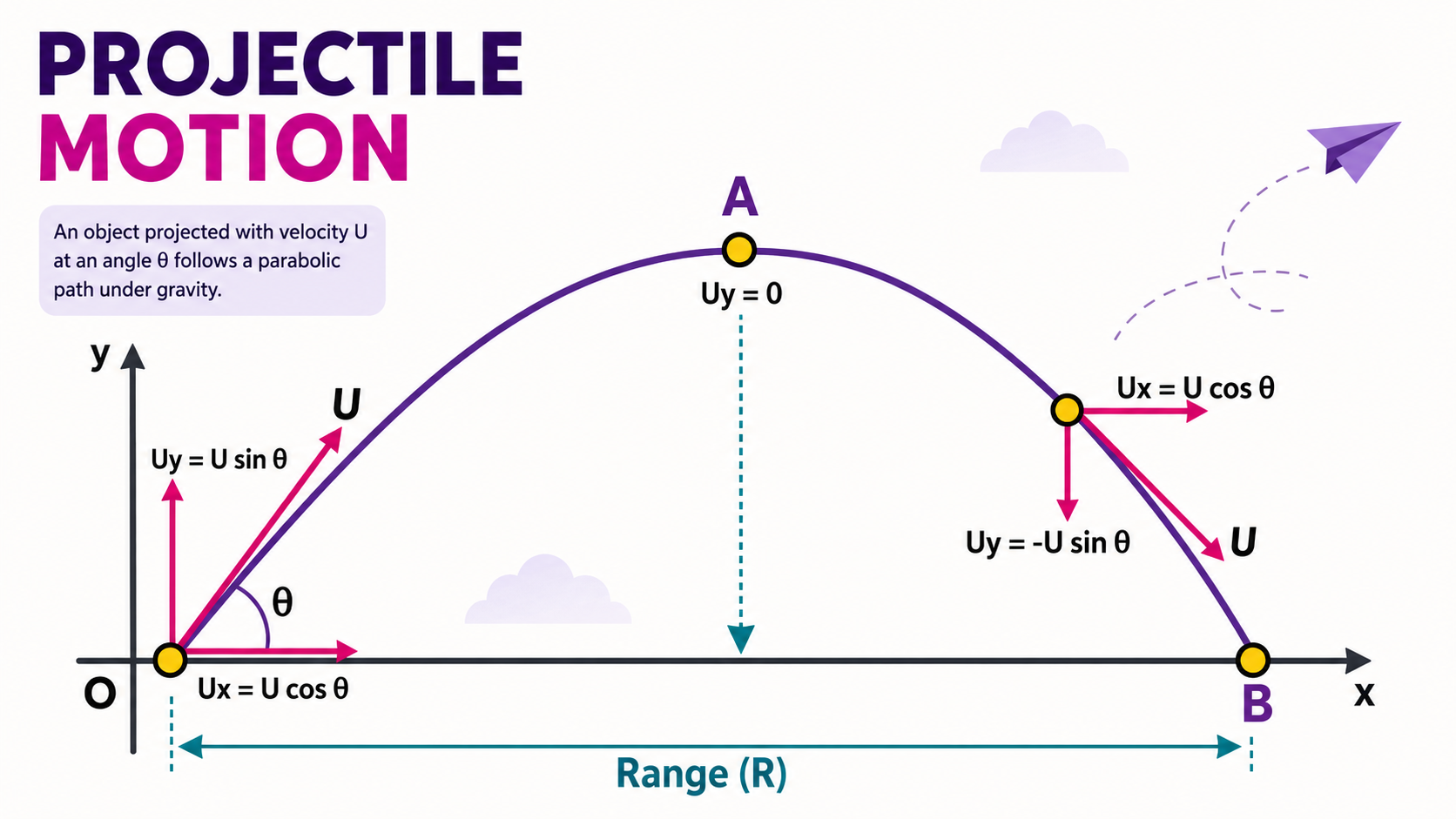
How to Solve Vertical Projectile Motion Questions
Vertical projectile motion is one of the most important topics in Grade 12 Physical Sciences. It often appears in exam questions because it tests whether you understand motion, acceleration, velocity, displacement, graphs and equations of motion.
The good news is that most vertical projectile motion questions follow the same pattern. Once you understand the basic rules and use a clear method, the questions become much easier.
This guide will explain everything students need to know to solve vertical projectile motion questions with confidence.
What is Vertical Projectile Motion?
Vertical projectile motion is the motion of an object that moves up or down under the influence of gravity.
The object may be:
- thrown vertically upwards
- thrown vertically downwards
- dropped from rest
- bouncing after hitting the ground
In these questions, the motion happens in one dimension: vertically up and down.
Examples include:
- a ball thrown straight up into the air
- a stone dropped from a building
- a ball thrown downward from a balcony
- a bouncing ball
- a coin tossed upward
In exam questions, air resistance is usually ignored unless the question states otherwise.
What is a Projectile?
A projectile is an object that is launched or released and then moves under the influence of gravity.
Once the object is in the air, gravity is the only force acting on it if air resistance is ignored.
This means the object accelerates downward throughout its motion.
The Most Important Idea: Gravity Always Acts Downward
In vertical projectile motion, the acceleration is caused by gravity.
Near Earth’s surface, the magnitude of gravitational acceleration is usually taken as:
9.8 m·s⁻²
Gravity always acts downward.
This is true whether the object is:
- moving upward
- momentarily at the top
- moving downward
- falling after being dropped
A very common mistake is thinking that acceleration is zero at the highest point. This is incorrect.
At the highest point:
- velocity is zero for an instant
- acceleration is still downward
Important Terms Students Must Know
Before solving questions, you need to understand the key terms.
Initial Velocity
Initial velocity is the velocity of the object at the start of the section of motion you are analysing.
It is often written as vᵢ.
Examples:
- If a ball is dropped from rest, its initial velocity is 0 m·s⁻¹.
- If a ball is thrown upward at 20 m·s⁻¹, its initial velocity is 20 m·s⁻¹ upward.
- If a ball is thrown downward at 5 m·s⁻¹, its initial velocity is 5 m·s⁻¹ downward.
Final Velocity
Final velocity is the velocity of the object at the end of the section of motion you are analysing.
It is often written as v𝒇.
At maximum height, the final velocity is zero if you are analysing the upward part of the motion.
Acceleration
Acceleration is the rate at which velocity changes.
In vertical projectile motion, acceleration is due to gravity.
Gravity causes the velocity to change by 9.8 m·s⁻¹ every second.
Time
Time is how long the motion takes.
It is usually measured in seconds.
Displacement
Displacement is the change in position from the starting point to the final point.
Displacement has direction.
This means it can be positive or negative depending on your sign convention.
Distance
Distance is the total path travelled.
Distance does not have direction.
Do not confuse distance with displacement.
For example, if a ball is thrown upward and returns to the same height, its displacement is zero, but the distance travelled is not zero.
Choose a Sign Convention First
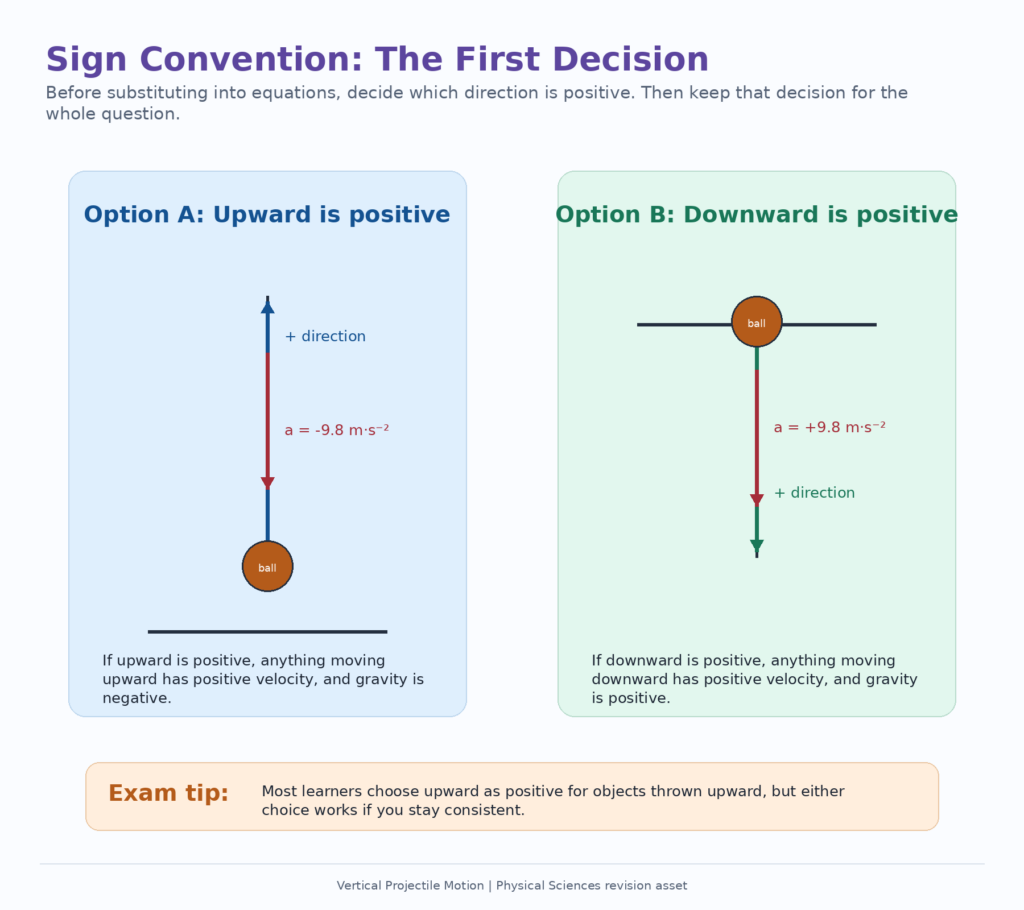
Before using any equation, choose which direction is positive.
This is one of the most important steps in vertical projectile motion.
You can choose:
- upward as positive
- downward as positive
Both methods can work, but you must stay consistent.
Option 1: Upward is Positive
If upward is positive:
- upward velocity is positive
- downward velocity is negative
- gravitational acceleration is negative
This means acceleration due to gravity is:
-9.8 m·s⁻²
Many learners prefer this method when an object is thrown upward.
Option 2: Downward is Positive
If downward is positive:
- downward velocity is positive
- upward velocity is negative
- gravitational acceleration is positive
This means acceleration due to gravity is:
+9.8 m·s⁻²
This method can be useful when an object is dropped or thrown downward.
Exam Tip on Sign Convention
The examiner does not usually care whether you choose upward or downward as positive.
What matters is that you are consistent.
If you choose upward as positive, do not suddenly treat downward as positive halfway through the question.
The Equations of Motion
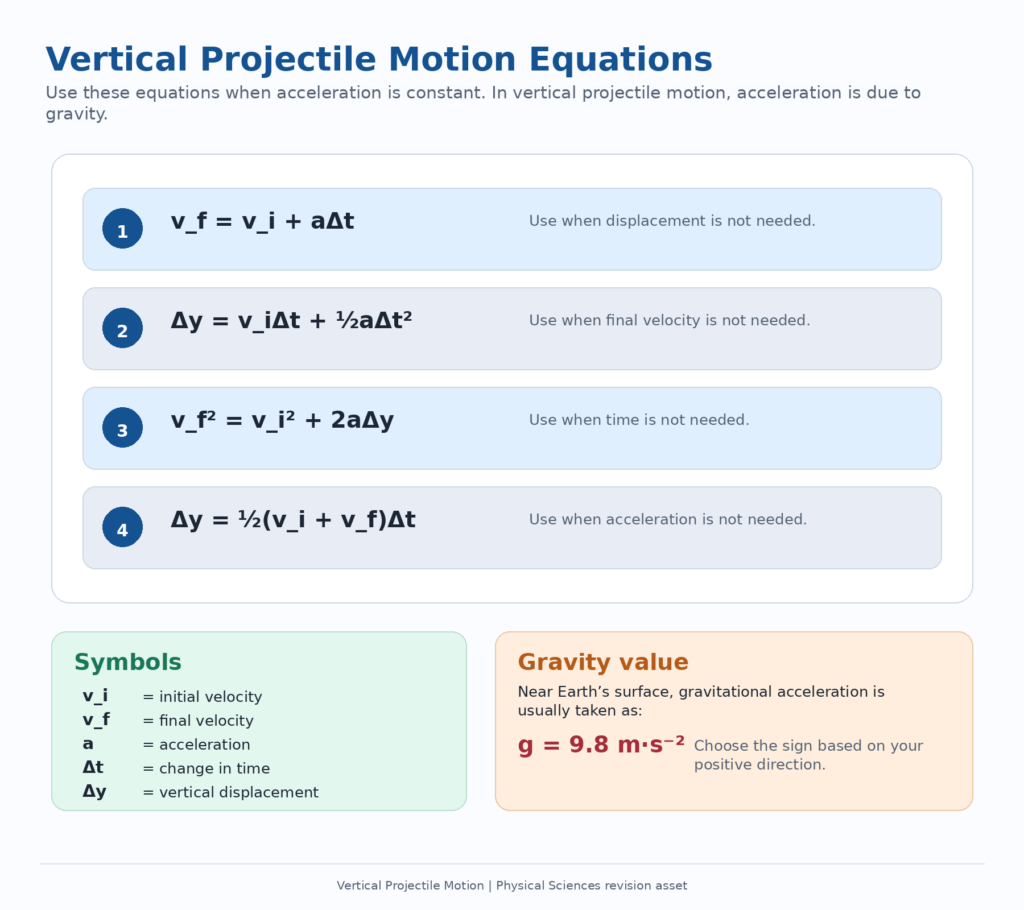
Vertical projectile motion uses the same equations of motion used for constant acceleration.
These equations work because acceleration due to gravity is constant when air resistance is ignored.
The main equations help you calculate:
- final velocity
- initial velocity
- acceleration
- time
- displacement
The secret is choosing the equation that contains the unknown you want and avoids unnecessary unknowns.
How to Choose the Correct Equation
When choosing an equation, ask yourself:
- What am I trying to find?
- What values do I already know?
- Which equation contains those values?
- Which equation avoids the value I do not know?
For example:
If the question does not give time and does not ask for time, use an equation that does not include time.
If the question asks for time and you know initial velocity, final velocity and acceleration, use the equation that links velocity, acceleration and time.
Object Thrown Vertically Upwards
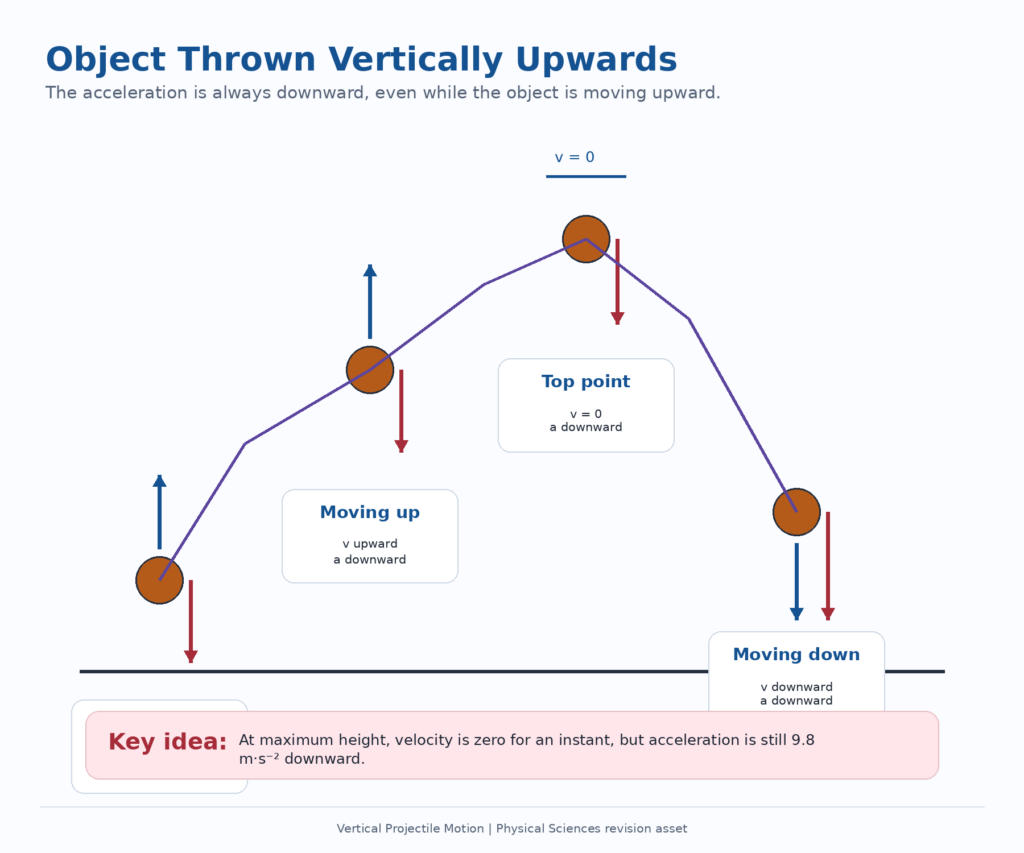
When an object is thrown vertically upwards, it starts with an upward velocity.
As it moves upward, gravity acts downward, so the object slows down.
Eventually, it reaches maximum height.
At maximum height:
- velocity is zero
- acceleration is still downward
- the object is about to change direction
After that, the object moves downward and speeds up because gravity is still pulling it down.
Key Points for an Object Thrown Upward
Students must remember:
- The object slows down while moving upward.
- The velocity at the top is zero.
- The acceleration at the top is not zero.
- The object speeds up while moving downward.
- If it returns to the same height, the time up equals the time down.
- If it returns to the same height, the speed just before reaching the ground is equal in magnitude to the launch speed, but in the opposite direction.
Object Dropped from Rest
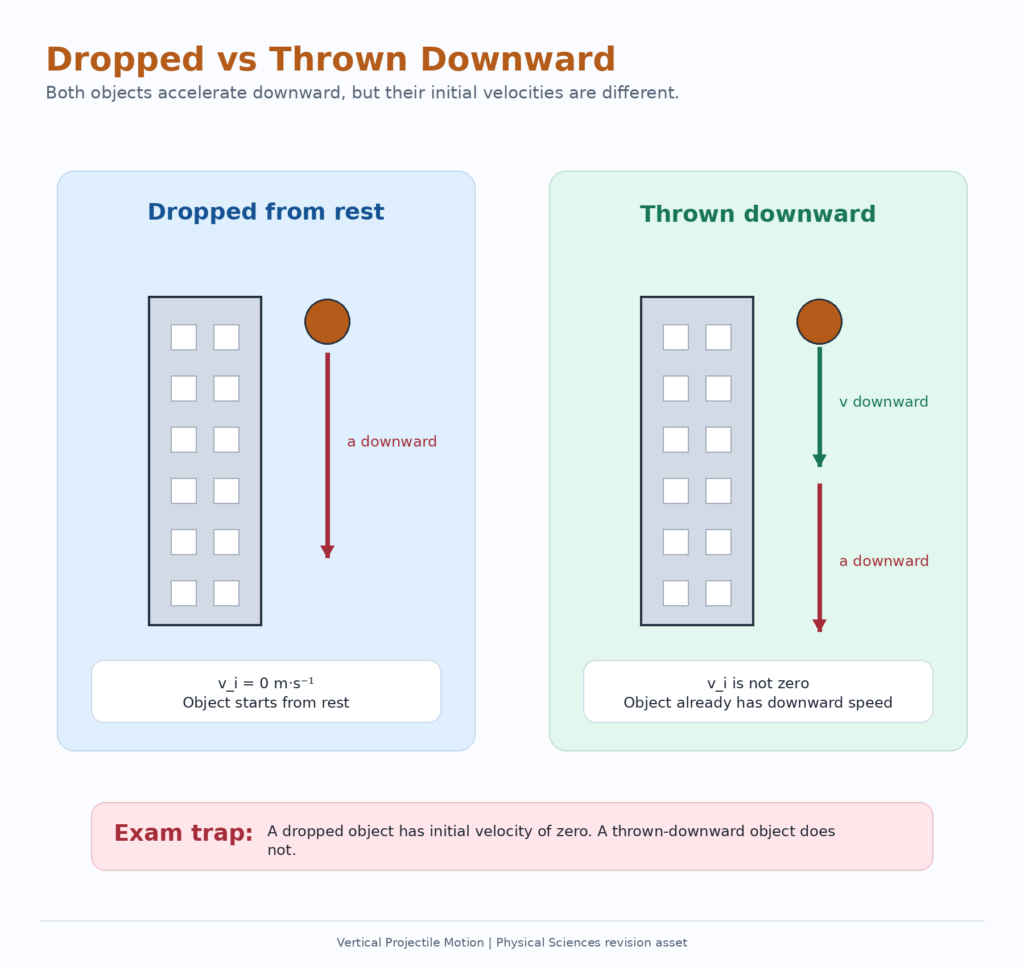
An object dropped from rest starts with zero initial velocity.
This means:
- it is not thrown
- it starts from rest
- its initial velocity is 0 m·s⁻¹
- it accelerates downward due to gravity
As it falls, its speed increases.
Object Thrown Downward
An object thrown downward does not start from rest.
It already has an initial downward velocity.
This means you must not use 0 m·s⁻¹ as the initial velocity unless the question says the object is dropped from rest.
This is a common exam trap.
Dropped vs Thrown Downward
The difference is simple:
A dropped object has an initial velocity of zero.
A thrown-downward object has an initial velocity greater than zero.
Both accelerate downward due to gravity.
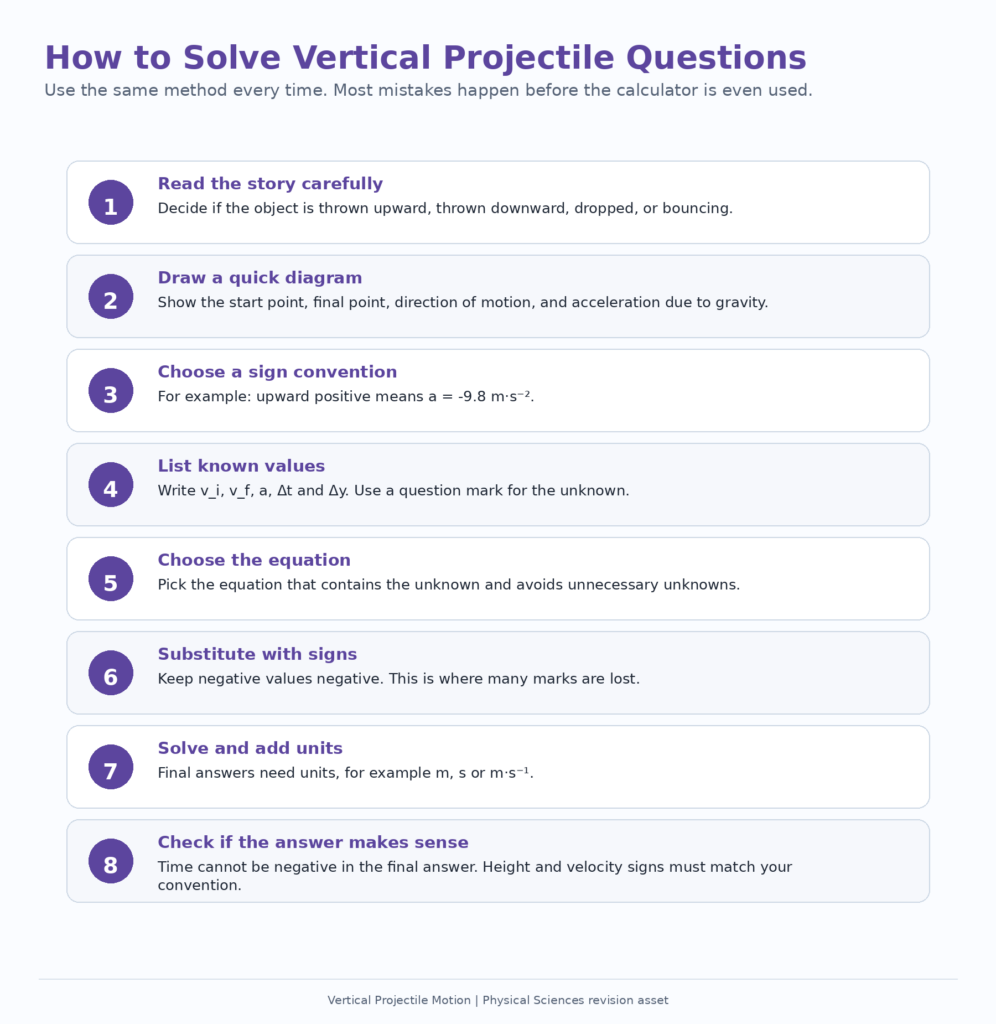
The Step-by-Step Method for Solving Questions
Use the same method every time.
Step 1: Read the Question Carefully
Identify what is happening.
Ask:
- Is the object thrown upward?
- Is it dropped?
- Is it thrown downward?
- Does it bounce?
- Is air resistance ignored?
- Does it return to the same height?
Step 2: Draw a Simple Diagram
Your diagram does not need to be perfect.
It should show:
- where the object starts
- where the object ends
- the direction of motion
- the acceleration due to gravity
- the positive direction you have chosen
A diagram helps prevent sign errors.
Step 3: Choose a Sign Convention
Decide whether upward or downward is positive.
Write your choice clearly.
For example:
“Take upward as positive.”
Then write the acceleration with the correct sign.
Step 4: List the Known Values
Write down the information from the question.
Use symbols such as:
- initial velocity
- final velocity
- acceleration
- time
- displacement
Put a question mark next to the unknown.
Step 5: Choose the Correct Equation
Choose the equation that contains your unknown and the values you know.
Do not choose an equation with too many unknowns.
Step 6: Substitute Carefully
Substitute the numbers into the equation.
Pay close attention to positive and negative signs.
This is where many learners lose marks.
Step 7: Solve
Use algebra and your calculator carefully.
Round your answer only at the end unless your teacher tells you otherwise.
Step 8: Add Units
Always include the correct unit.
Examples:
- displacement: m
- time: s
- velocity: m·s⁻¹
- acceleration: m·s⁻²
Step 9: Check if Your Answer Makes Sense
Ask:
- Can time be negative? No.
- Is the object moving up or down?
- Should the velocity be positive or negative?
- Is the displacement above or below the starting point?
- Does the answer make sense physically?
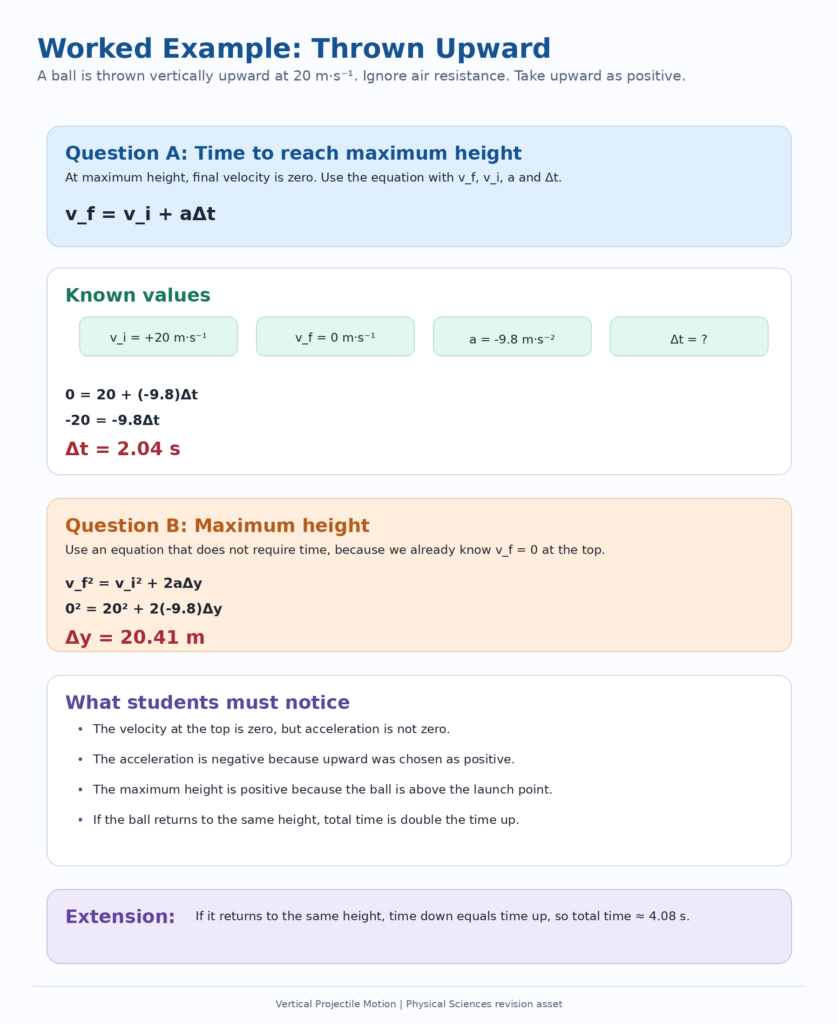
Worked Example: Ball Thrown Upward
A ball is thrown vertically upward at 20 m·s⁻¹. Ignore air resistance. Take upward as positive.
Question A: How long does it take to reach maximum height?
Question B: What is the maximum height reached?
How to Think About the Question
Because the ball is thrown upward, it slows down as it rises.
At maximum height, its velocity is zero.
Since upward is positive, acceleration due to gravity is negative.
For Question A, use the equation that links initial velocity, final velocity, acceleration and time.
For Question B, use the equation that links initial velocity, final velocity, acceleration and displacement.
What Students Must Notice
At maximum height:
- final velocity is zero
- acceleration is not zero
- displacement is positive because the ball is above the starting point
If the ball returns to the same height, the total time in the air is double the time taken to reach maximum height.
Graphs in Vertical Projectile Motion
Vertical projectile motion questions often include graphs.
You may need to interpret:
- position-time graphs
- velocity-time graphs
- acceleration-time graphs
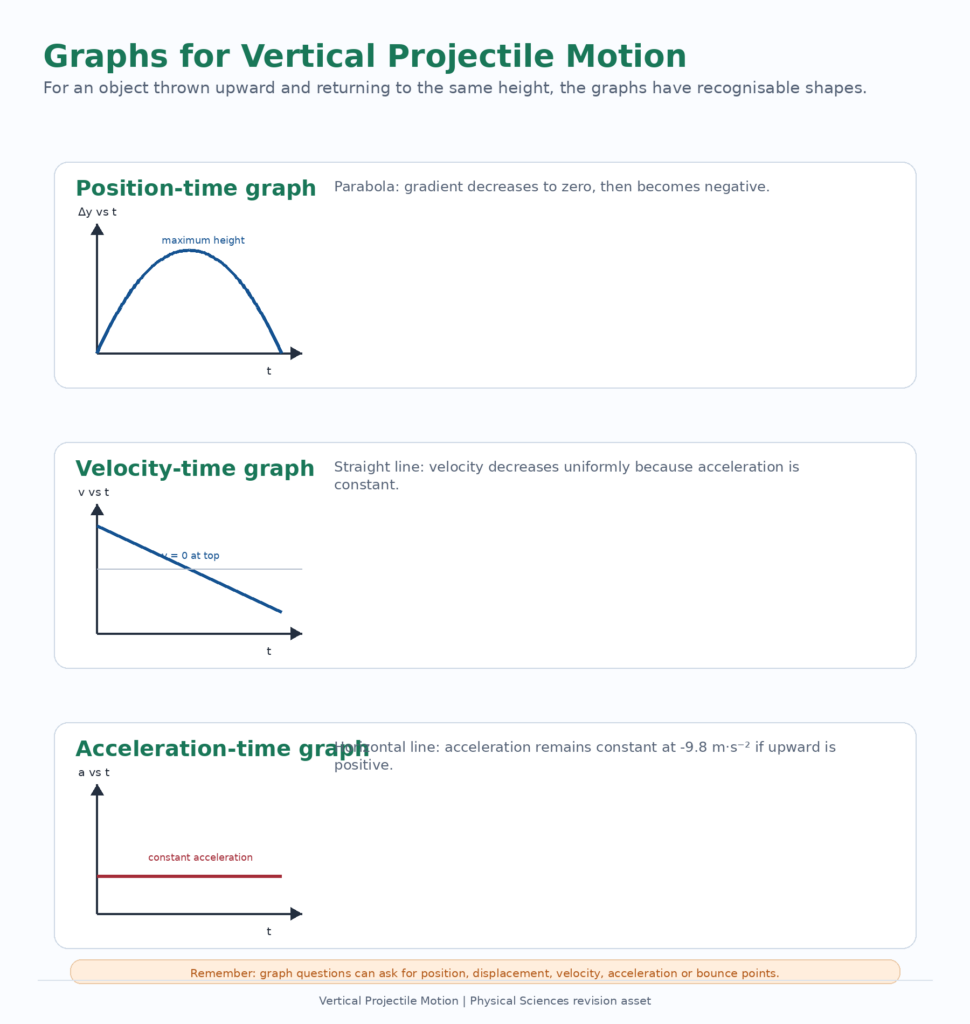
Position-Time Graphs
A position-time graph shows how the object’s position changes over time.
For an object thrown upward and returning to the same height, the position-time graph is a curve.
The graph rises as the object moves upward, reaches a maximum point, and then curves downward as the object falls.
The gradient of a position-time graph represents velocity.
This means:
- positive gradient means upward motion
- zero gradient means the object is at maximum height
- negative gradient means downward motion
Velocity-Time Graphs
A velocity-time graph shows how velocity changes over time.
For vertical projectile motion, the velocity-time graph is a straight line because acceleration is constant.
If upward is positive, the graph slopes downward.
The gradient of a velocity-time graph represents acceleration.
The area under a velocity-time graph represents displacement.
Important points:
- velocity is positive while the object moves upward
- velocity is zero at maximum height
- velocity is negative while the object moves downward
Acceleration-Time Graphs
An acceleration-time graph shows the acceleration of the object over time.
For vertical projectile motion, acceleration is constant.
If upward is positive, acceleration is shown as a horizontal line below the time axis.
If downward is positive, acceleration is shown as a horizontal line above the time axis.
Bouncing Ball Questions
Bouncing ball questions are often graph-based.
They test whether you can identify what happens when the ball hits the ground.
[Insert Image 8: Bouncing Ball Graph Interpretation]
When a ball bounces:
- it touches the ground
- its velocity changes direction
- it loses some energy
- it usually reaches a lower height after each bounce
On a position-time graph, each bounce occurs where the height is zero.
After each bounce, the next maximum height is usually lower than the previous one.
This shows that mechanical energy has been lost to sound, heat and deformation.
Important Bouncing Ball Ideas
When the ball hits the ground:
- the ball changes direction
- velocity changes suddenly
- acceleration due to gravity still acts downward while the ball is in the air
- the height after the bounce is usually lower than before
If the graph shows lower and lower peaks, the ball is losing energy.
Common Types of Exam Questions
1. Find the Time to Maximum Height
Use the fact that velocity at maximum height is zero.
Then choose an equation involving initial velocity, final velocity, acceleration and time.
2. Find the Maximum Height
Use the fact that final velocity at the top is zero.
Choose an equation that does not require time if time is not given.
3. Find the Total Time in the Air
If the object returns to the same height from which it was launched, the time up equals the time down.
Total time is:
time up + time down
If the object lands at a different height, you must calculate the time using the equations of motion.
4. Find the Velocity Just Before Hitting the Ground
Use the displacement from the starting point to the ground.
Pay attention to direction.
If upward is positive and the object is moving downward, the final velocity should be negative.
5. Find the Height After a Certain Time
Use the equation involving displacement, initial velocity, acceleration and time.
Remember that displacement is measured from the starting point, not necessarily from the ground.
6. Interpret a Graph
Look carefully at the graph type.
Ask:
- Is it position-time?
- Is it velocity-time?
- Is it acceleration-time?
- What does the gradient represent?
- What does the area represent?
- Where does the object change direction?
- Where does it hit the ground?
https://youtu.be/uEnUG_1TYxc?si=fHTwlK_eoUA7qkiJ
Common Mistakes to Avoid
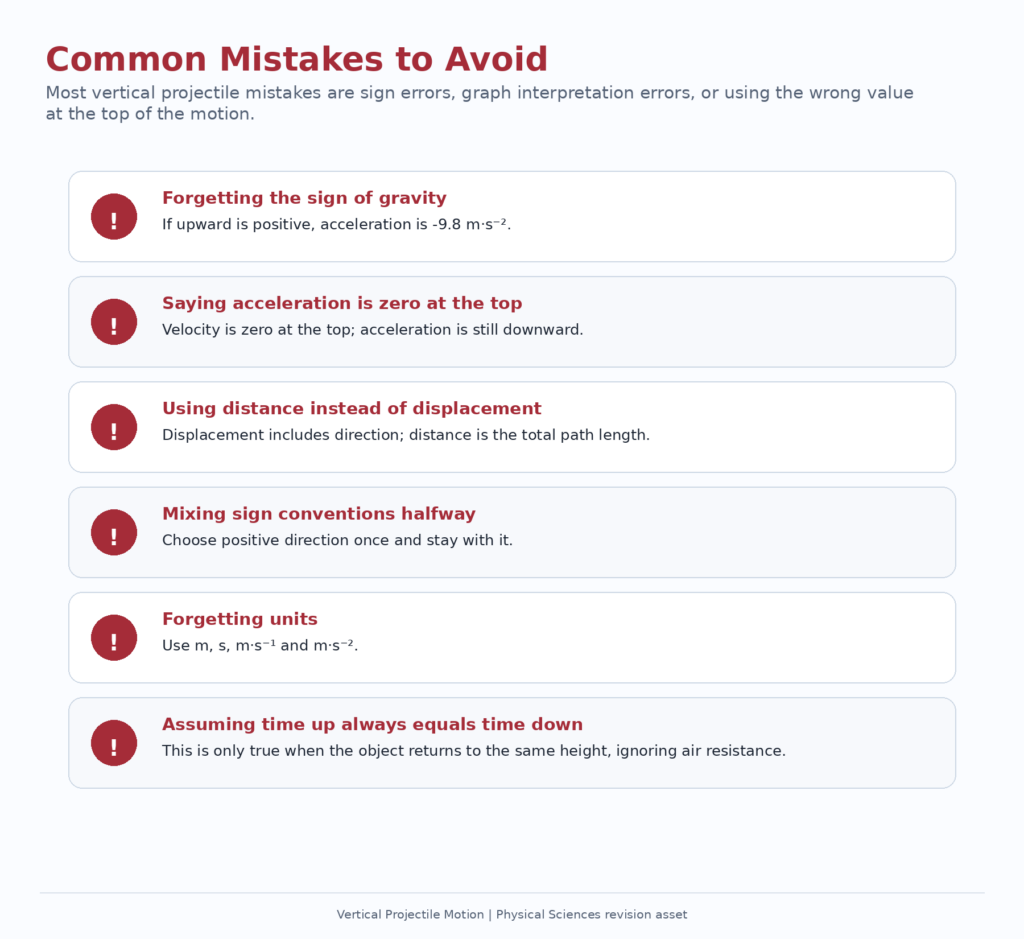
Mistake 1: Saying Acceleration is Zero at the Top
This is wrong.
At the top, velocity is zero, but acceleration is still 9.8 m·s⁻² downward.
Mistake 2: Forgetting the Sign of Gravity
If upward is positive, gravity is negative.
If downward is positive, gravity is positive.
Mistake 3: Confusing Distance and Displacement
Distance is the total path travelled.
Displacement is the change in position from start to finish.
If a ball goes up and comes back to the starting point, displacement is zero.
But the distance travelled is not zero.
Mistake 4: Using 0 m·s⁻¹ for Every Initial Velocity
Only use 0 m·s⁻¹ if the object is dropped from rest.
If the object is thrown upward or downward, it has an initial velocity.
Mistake 5: Ignoring Direction
Velocity, acceleration and displacement are vector quantities.
They have direction.
Direction affects the sign of the value.
Mistake 6: Rounding Too Early
Rounding too early can make your final answer inaccurate.
Keep enough decimal places during calculations and round at the end.
Mistake 7: Forgetting Units
An answer without units may lose marks.
Always include the correct unit.
How to Answer Graph Questions
For graph questions, first identify the graph.
If it is a Position-Time Graph
The gradient gives velocity.
A turning point shows maximum height.
A steeper gradient means greater speed.
Where the graph touches height zero, the object is at ground level.
If it is a Velocity-Time Graph
The gradient gives acceleration.
The area under the graph gives displacement.
Where the graph crosses the time axis, velocity is zero.
This often represents maximum height.
If it is an Acceleration-Time Graph
The graph should be horizontal if acceleration is constant.
The value is usually 9.8 m·s⁻², with the sign depending on the chosen direction.
Exam Words Students Should Understand
Calculate
You must show working and find a numerical answer.
Determine
You must work out the answer using information given.
Define
You must give the meaning of a term.
Explain
You must give a reason or describe the cause-and-effect relationship.
Sketch
You must draw the general shape of a graph and label important features.
Interpret
You must explain what information a graph or diagram is showing.
Quick Revision Checklist
Before the exam, make sure you can:
- define vertical projectile motion
- explain acceleration due to gravity
- choose a sign convention
- use the equations of motion
- identify velocity at maximum height
- solve for time, height, displacement and velocity
- distinguish between distance and displacement
- interpret position-time graphs
- interpret velocity-time graphs
- interpret acceleration-time graphs
- solve dropped-object questions
- solve thrown-upward questions
- solve thrown-downward questions
- understand bouncing-ball graphs
Final Exam Tips
Vertical projectile motion becomes easier when you follow a routine.
Always:
- Draw a diagram.
- Choose a positive direction.
- List your known values.
- Choose the correct equation.
- Substitute signs carefully.
- Solve step by step.
- Add units.
- Check whether the answer makes sense.
The biggest secret is consistency.
If you choose upward as positive, keep upward positive until the end of the question.
If you remember that gravity always acts downward and that velocity is zero at maximum height, you will already avoid two of the most common mistakes in this topic.
https://youtu.be/hH-tz-1DYDk?si=qfP46OKDWop-6Bjb
High School Study Resources
Click here to get 1 year’s free access to our online study resources.