
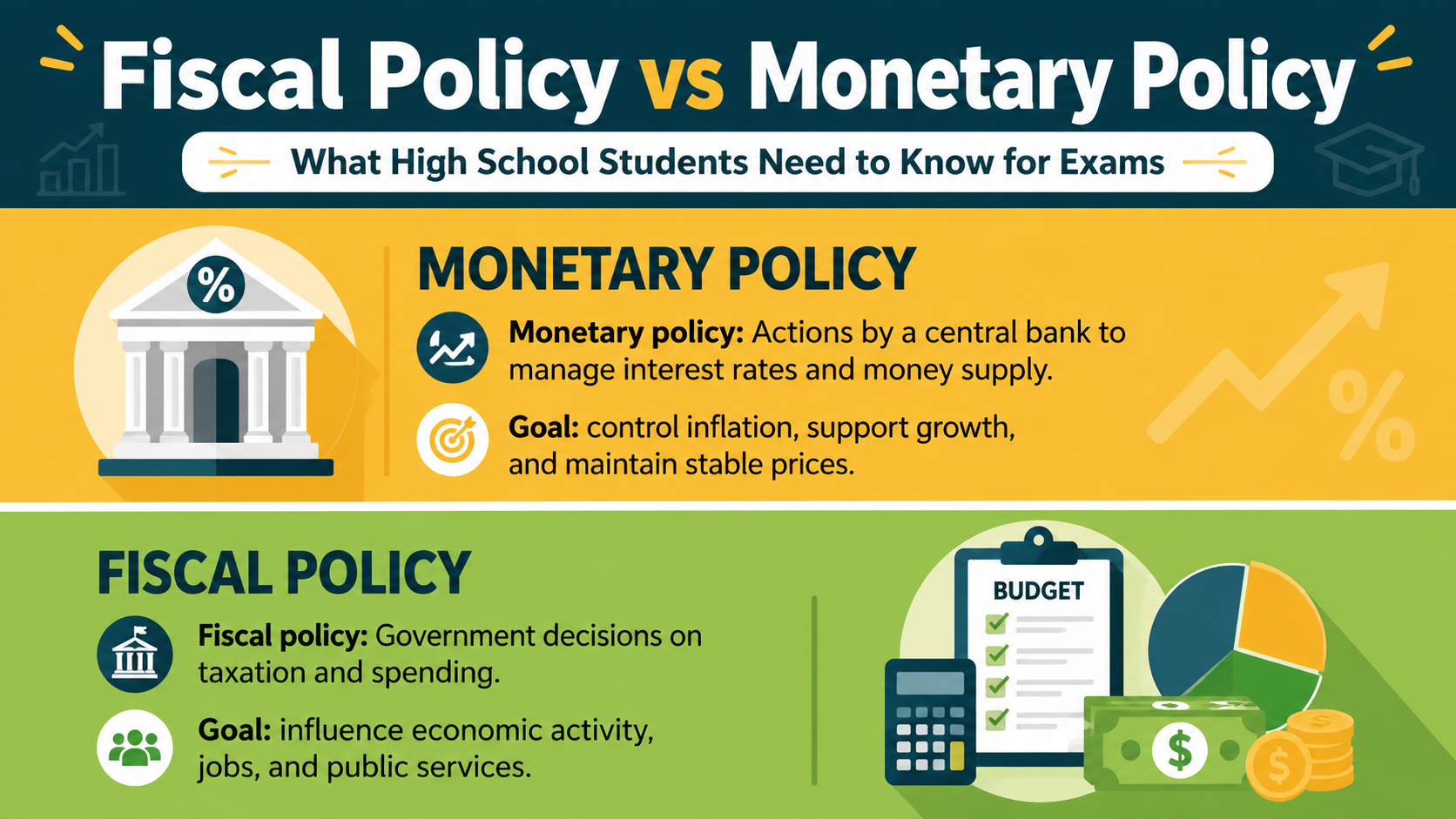
Fiscal policy and monetary policy are two of the most important tools used to influence a country’s economy. In Economics exams, learners are often asked to define them, compare them, explain their effects, and apply them to real economic problems such as inflation, unemployment, low economic growth or budget deficits.
The easiest way to understand the difference is this:
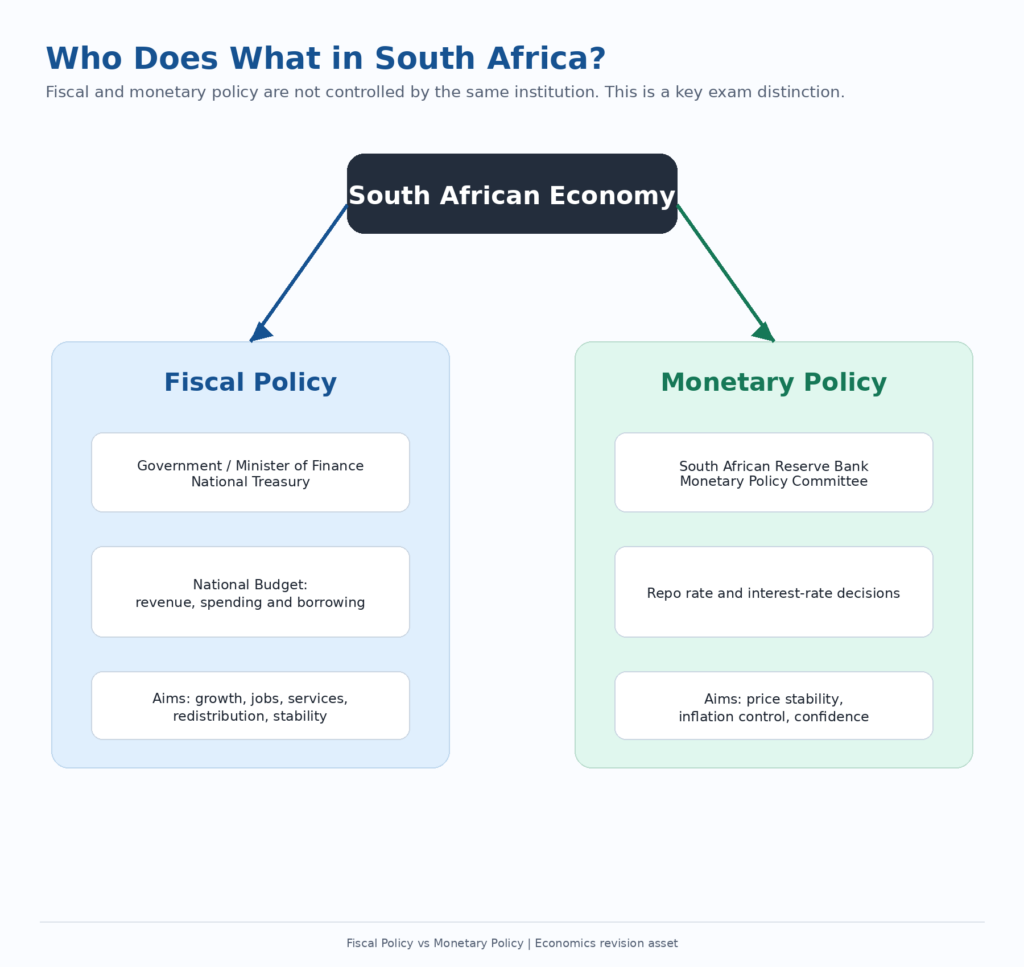
Fiscal policy is controlled by government and uses taxation, government spending and borrowing.
Monetary policy is controlled by the central bank and uses interest rates and money supply tools.
Both policies affect the economy, but they do it in different ways.

What is Fiscal Policy?
Fiscal policy refers to the way government uses taxation, government spending and borrowing to influence the economy.
In South Africa, fiscal policy is linked to the National Budget, which is presented by the Minister of Finance. Through the budget, government decides how much money it expects to collect, how much it plans to spend, and whether it needs to borrow money.
Fiscal policy affects the economy because government can influence:
- household income
- business activity
- employment
- public services
- infrastructure development
- redistribution of income
- economic growth
- aggregate demand
In simple terms, fiscal policy is about how government earns and spends money.
Main Tools of Fiscal Policy
There are three main tools of fiscal policy:
- taxation
- government spending
- government borrowing
1. Taxation
Taxes are the money collected by government from households and businesses.
Examples include:
- personal income tax
- company tax
- value-added tax, also called VAT
- fuel levies
- customs duties
- excise duties
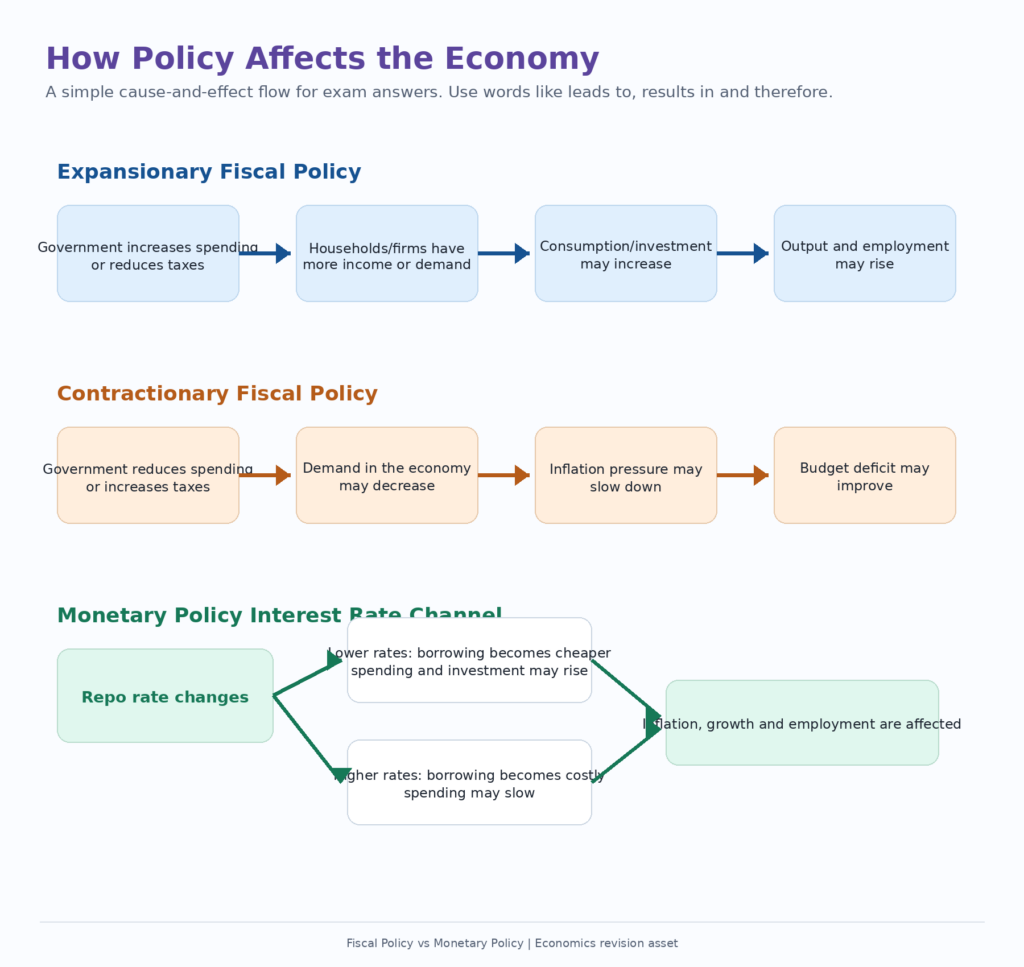
If government increases taxes, households and businesses may have less money to spend. This can reduce demand in the economy.
If government decreases taxes, households and businesses may have more money available. This can increase spending and investment.
2. Government Spending
Government spending refers to the money government uses to provide goods, services and infrastructure.
Examples include spending on:
- education
- healthcare
- social grants
- roads
- electricity infrastructure
- policing
- housing
- public transport
If government increases spending, it can create jobs and increase demand for goods and services.
If government reduces spending, it may reduce demand in the economy, but it can also help government control debt and budget deficits.
3. Government Borrowing
When government spends more than it receives in revenue, it may need to borrow money.
This creates a budget deficit.
A budget deficit means:
Government expenditure is greater than government revenue.
Borrowing can help government fund important services and infrastructure, but too much borrowing can increase public debt and interest payments.
What is Monetary Policy?
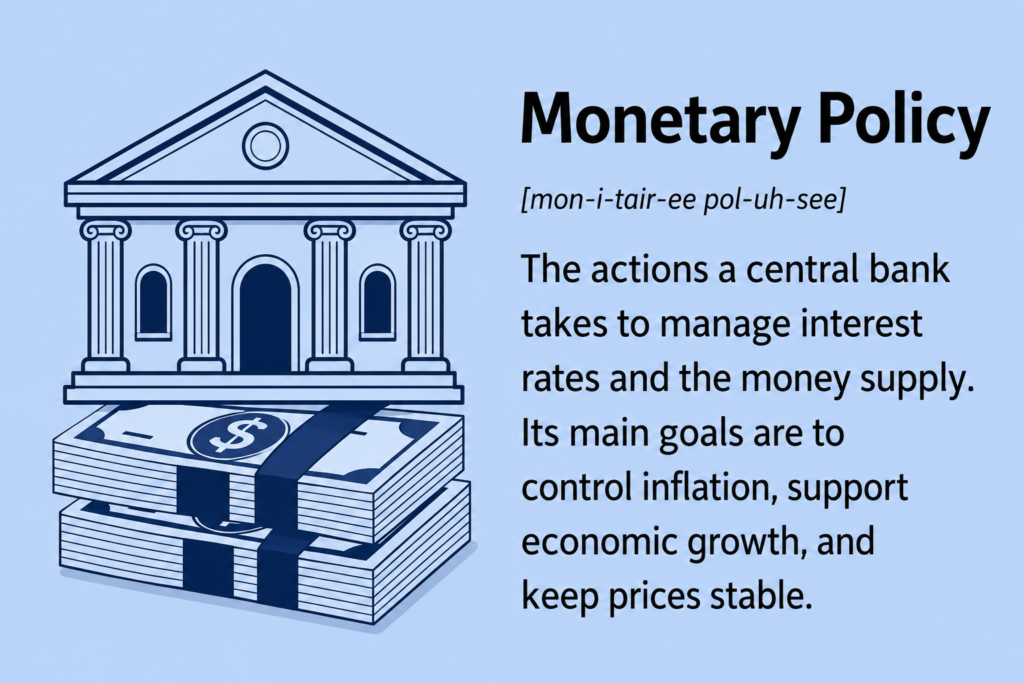
Monetary policy refers to the actions taken by a country’s central bank to influence the supply of money, credit and interest rates in the economy.
In South Africa, monetary policy is controlled by the South African Reserve Bank, also called the SARB.
The main aim of monetary policy is to maintain price stability, which means keeping inflation under control.
Inflation is a sustained increase in the general price level of goods and services. When inflation is too high, money loses value and the cost of living increases.
The SARB uses monetary policy to influence:
- interest rates
- borrowing
- saving
- spending
- investment
- inflation
- exchange rates
- business confidence
Main Tools of Monetary Policy
The most important tool of monetary policy for high school Economics learners is the repo rate.
What is the Repo Rate?
The repo rate is the interest rate at which the South African Reserve Bank lends money to commercial banks.
When the SARB changes the repo rate, commercial banks usually adjust their own interest rates.
This affects the cost of borrowing for households and businesses.
For example:
- If the repo rate increases, loans become more expensive.
- If the repo rate decreases, loans become cheaper.
This affects spending, saving and investment in the economy.
How Monetary Policy Works
If inflation is too high, the SARB may increase interest rates.
Higher interest rates make borrowing more expensive. This means households and businesses may borrow less and spend less. As spending slows, demand decreases, which can help reduce inflation pressure.
If economic growth is weak, the SARB may decrease interest rates.
Lower interest rates make borrowing cheaper. This can encourage households and businesses to borrow, spend and invest more. This can increase demand and support economic growth.
Expansionary Fiscal Policy
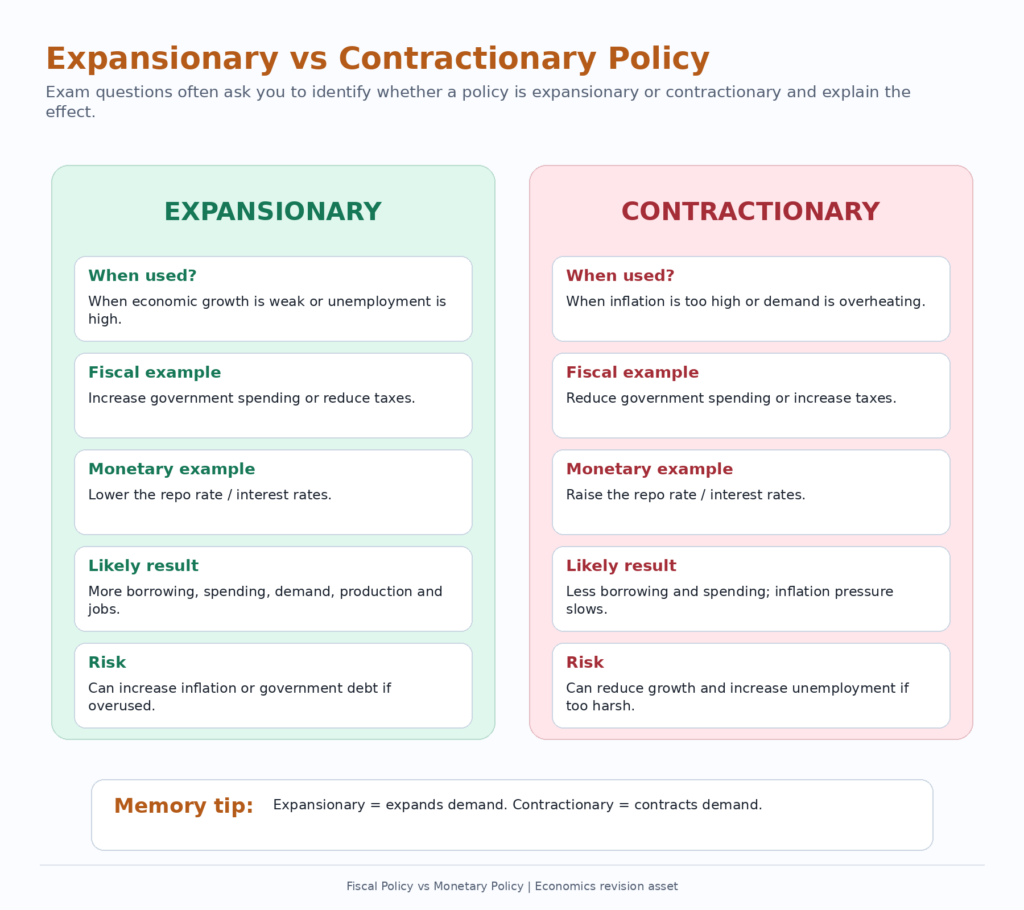
Expansionary fiscal policy is used when government wants to stimulate the economy.
This may happen when:
- economic growth is low
- unemployment is high
- consumer spending is weak
- businesses are not investing enough
Government can use expansionary fiscal policy by:
- increasing government spending
- decreasing taxes
- increasing social grants or transfers
- investing in infrastructure projects
Example
If government spends more on building roads, schools or hospitals, construction companies may receive more work. These companies may hire more workers, buy more materials and pay more wages. Workers then have income to spend, which increases demand in the economy.
Effects of Expansionary Fiscal Policy
Expansionary fiscal policy can lead to:
- higher aggregate demand
- increased production
- more employment
- higher household income
- stronger economic growth
Possible Problems
Expansionary fiscal policy can also cause problems if it is overused.
It may lead to:
- higher inflation
- a larger budget deficit
- more government borrowing
- higher public debt
Contractionary Fiscal Policy
Contractionary fiscal policy is used when government wants to slow down demand in the economy or improve public finances.
This may happen when:
- inflation is too high
- government debt is too high
- the budget deficit is too large
- the economy is overheating
Government can use contractionary fiscal policy by:
- decreasing government spending
- increasing taxes
- reducing borrowing
- cutting unnecessary expenditure
Example
If government increases taxes, households may have less disposable income. This can reduce consumer spending. Lower spending can reduce demand in the economy and help slow inflation pressure.
Effects of Contractionary Fiscal Policy
Contractionary fiscal policy can lead to:
- lower aggregate demand
- reduced inflation pressure
- improved budget balance
- lower borrowing needs
Possible Problems
Contractionary fiscal policy can also have negative effects.
It may lead to:
- slower economic growth
- lower consumer spending
- fewer job opportunities
- reduced public services if spending cuts are too severe
Expansionary Monetary Policy
Expansionary monetary policy is used when the central bank wants to stimulate the economy.
The SARB may use expansionary monetary policy by lowering interest rates.
Lower interest rates can encourage:
- more borrowing
- more household spending
- more business investment
- higher aggregate demand
- stronger economic growth
Example
If interest rates decrease, car finance, home loans and business loans may become more affordable. Consumers and firms may borrow more, which can increase spending and investment.
Possible Problems
Expansionary monetary policy can increase inflation if demand rises too quickly.
It can also encourage too much borrowing if consumers and businesses take on more debt than they can afford.
Contractionary Monetary Policy
Contractionary monetary policy is used when the central bank wants to reduce inflation pressure.
The SARB may use contractionary monetary policy by increasing interest rates.
Higher interest rates can lead to:
- less borrowing
- more saving
- lower consumer spending
- lower investment
- reduced aggregate demand
- lower inflation pressure
Example
If interest rates increase, loan repayments become more expensive. Households may spend less on goods and services because more of their income goes toward debt repayments. Businesses may delay investment because borrowing is more expensive.
Possible Problems
Contractionary monetary policy can slow economic growth.
It may also increase unemployment if businesses produce less or delay expansion.
Key Difference Between Fiscal and Monetary Policy
The biggest difference is who controls the policy and what tools they use.
Fiscal policy is controlled by government.
Monetary policy is controlled by the central bank.
Fiscal policy uses government spending and taxation.
Monetary policy uses interest rates and money supply tools.
Fiscal policy is linked to the national budget.
Monetary policy is linked to inflation targeting and price stability.
Fiscal Policy vs Monetary Policy Table
| Feature | Fiscal Policy | Monetary Policy |
|---|---|---|
| Controlled by | Government | South African Reserve Bank |
| Main decision-makers | Minister of Finance and National Treasury | Monetary Policy Committee |
| Main tools | Taxation, spending and borrowing | Repo rate, interest rates and money supply tools |
| Main aim | Influence growth, employment, public services and redistribution | Control inflation and maintain price stability |
| Linked to | National Budget | Inflation targeting |
| Expansionary example | Increase spending or reduce taxes | Lower interest rates |
| Contractionary example | Reduce spending or increase taxes | Raise interest rates |
| Direct impact | Government budget, public services, income and demand | Cost of borrowing, saving, spending and inflation |
| Time effect | Can take time due to budget processes and implementation | Can affect markets quickly, but full economic effects take time |
Aggregate Demand and Policy
Both fiscal and monetary policy affect aggregate demand.
Aggregate demand is the total demand for goods and services in the economy.
It includes:
- consumption by households
- investment by businesses
- government spending
- net exports
Expansionary policy increases aggregate demand.
Contractionary policy decreases aggregate demand.
This is important because changes in aggregate demand can affect:
- production
- employment
- inflation
- income
- economic growth
The Policy Mix
The policy mix refers to the way fiscal and monetary policy work together.
Sometimes, both policies move in the same direction.
For example, if the economy is in a recession:
- government may increase spending
- the central bank may lower interest rates
Both actions support economic growth.
Sometimes, the policies may move in different directions.
For example:
- government may increase spending to support jobs
- the central bank may raise interest rates to fight inflation
This can create tension because one policy stimulates demand while the other tries to reduce it.
[Insert Image 6: Policy Mix Venn Diagram]
Why Fiscal and Monetary Policy Matter
Fiscal and monetary policy are important because they help manage major economic problems.
1. Inflation
If inflation is too high, monetary policy can raise interest rates to reduce spending.
Fiscal policy can also reduce demand by increasing taxes or cutting spending.
2. Unemployment
If unemployment is high, fiscal policy can increase spending on infrastructure or public programmes.
Monetary policy can lower interest rates to encourage investment and spending.
3. Low Economic Growth
If growth is weak, expansionary fiscal or monetary policy can help increase demand.
Government can spend more, while the central bank can lower interest rates.
4. Budget Deficit
If government spends more than it earns, it has a budget deficit.
Fiscal policy can help reduce the deficit by increasing revenue or reducing spending.
5. Public Debt
If government borrows too much over time, public debt increases.
Fiscal policy must balance the need for growth with the need to keep debt sustainable.
Common Exam Questions
Learners may be asked questions such as:
- Define fiscal policy.
- Define monetary policy.
- Distinguish between fiscal policy and monetary policy.
- Explain how an increase in interest rates affects inflation.
- Explain how government spending can reduce unemployment.
- Discuss the effects of expansionary fiscal policy.
- Discuss the effects of contractionary monetary policy.
- Explain how taxation can be used to influence aggregate demand.
- Evaluate the effectiveness of fiscal policy in reducing unemployment.
- Compare the role of the National Treasury and the South African Reserve Bank.
How to Answer Exam Questions
When answering exam questions, do not only list facts. Explain the chain of effects.

A good answer should follow this structure:
Step 1: Define the policy
Start with a clear definition.
Example:
Fiscal policy is the use of government spending, taxation and borrowing to influence economic activity.
Step 2: Name the institution
Mention who controls it.
Example:
Fiscal policy is controlled by government, while monetary policy is controlled by the South African Reserve Bank.
Step 3: Identify the tool
Say which tool is being used.
Example:
An increase in the repo rate is a monetary policy tool.
Step 4: Explain the effect
Show how the policy affects the economy.
Example:
If the repo rate increases, commercial banks increase interest rates. Borrowing becomes more expensive. Consumers and businesses borrow less, spending decreases, aggregate demand falls, and inflation pressure may decrease.
Step 5: Mention possible disadvantages
For higher-level answers, include limitations.
Example:
Higher interest rates may reduce inflation, but they can also slow economic growth and increase unemployment.
Useful Exam Phrases
Use phrases such as:
- This leads to…
- As a result…
- This causes…
- This reduces aggregate demand…
- This increases disposable income…
- This encourages borrowing and investment…
- This may reduce inflationary pressure…
- This may stimulate economic growth…
- However, a possible disadvantage is…
These phrases help you write clear cause-and-effect answers.
Common Mistakes Learners Make
Mistake 1: Saying fiscal policy is controlled by the Reserve Bank
This is incorrect.
Fiscal policy is controlled by government.
Monetary policy is controlled by the South African Reserve Bank.
Mistake 2: Confusing tax with interest rates
Taxation is a fiscal policy tool.
Interest rates are a monetary policy tool.
Mistake 3: Forgetting to explain the effect
In exams, do not only write:
“The repo rate increases.”
Rather explain:
“When the repo rate increases, borrowing becomes more expensive. This reduces spending and aggregate demand, which can help reduce inflation.”
Mistake 4: Thinking expansionary policy is always good
Expansionary policy can create jobs and growth, but it can also increase inflation, debt or budget deficits.
Mistake 5: Thinking contractionary policy is always bad
Contractionary policy can slow growth, but it may be necessary to reduce inflation or improve government finances.
Quick Revision Summary
Fiscal policy:
- controlled by government
- uses taxes, spending and borrowing
- linked to the National Budget
- affects aggregate demand, employment, growth and redistribution
Monetary policy:
- controlled by the South African Reserve Bank
- uses interest rates and money supply tools
- linked to inflation targeting and price stability
- affects borrowing, saving, spending, investment and inflation
Expansionary policy:
- increases demand
- supports growth and employment
- may increase inflation or debt
Contractionary policy:
- decreases demand
- helps reduce inflation or deficits
- may slow growth and employment
Final Exam Tip
When comparing fiscal and monetary policy, always remember the three big differences:
- Who controls it?
- What tools are used?
- What is the main aim?
If you can answer those three questions clearly, you will be able to handle most exam questions on fiscal policy and monetary policy.
Fiscal policy is about government’s budget decisions.
Monetary policy is about the central bank’s interest rate and money supply decisions.
Both are used to manage the economy, but they work through different channels.

