Organic Chemistry can feel difficult at first because there are many names, formulas and reactions to remember. But once you understand functional groups, the topic becomes much easier.
A functional group is the part of an organic molecule that gives the molecule its special chemical properties. It helps you identify the homologous series, name the compound correctly and predict the type of reactions it can undergo.
In exams, learners are often expected to look at a structural formula and answer questions such as:
- What is the homologous series?
- What is the IUPAC name?
- What is the functional group?
- What type of reaction is taking place?
- What product will form?
This guide will help you understand the functional groups you need to know.
1. What is Organic Chemistry?
Organic Chemistry is the study of carbon-containing compounds. Carbon is important because it can form strong bonds with other carbon atoms, allowing it to create long chains, branched chains and rings.
Most organic compounds contain carbon and hydrogen. Some also contain oxygen, nitrogen, halogens or other elements.
Examples of organic compounds include:
- methane in natural gas
- ethanol in some fuels and alcoholic drinks
- ethanoic acid in vinegar
- esters used in perfumes and flavourings
- plastics made from polymers
In school-level Organic Chemistry, you must understand how carbon chains are built, how they are named and how their functional groups affect their reactions.
2. What is a Functional Group?
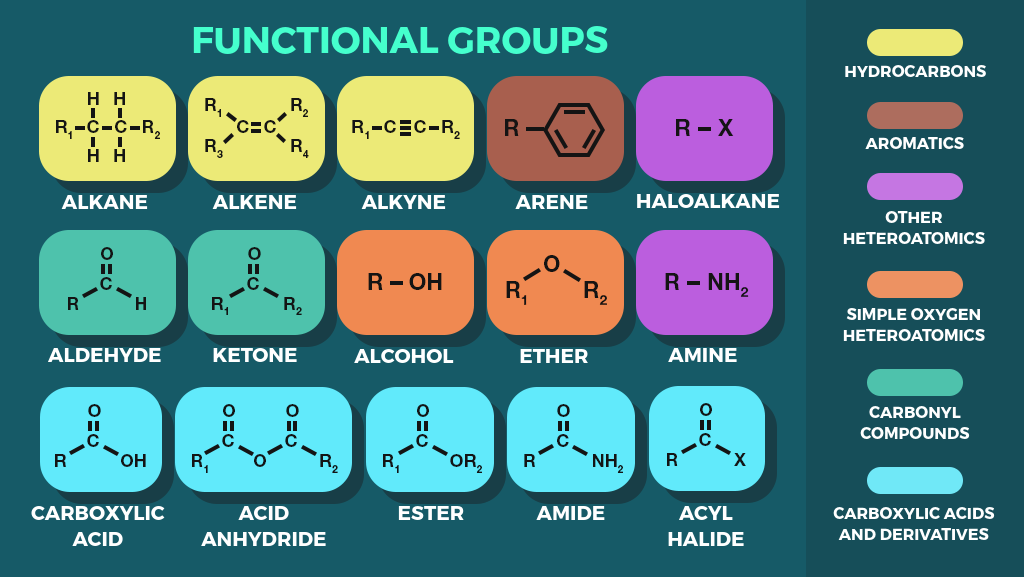
A functional group is an atom, bond or group of atoms in an organic molecule that determines how the molecule behaves chemically.
Think of it as the “active part” of the molecule.
For example:
- If a molecule has an -OH group, it is usually an alcohol.
- If it has a C=C double bond, it is an alkene.
- If it has a -COOH group, it is a carboxylic acid.
- If it has a -COO- group, it is an ester.
Once you find the functional group, you can usually identify the homologous series.
3. What is a Homologous Series?
A homologous series is a family of organic compounds with:
- the same functional group
- the same general formula
- similar chemical properties
- a gradual change in physical properties as the carbon chain gets longer
For example, methane, ethane, propane and butane all belong to the alkane homologous series.
They all have single carbon-carbon bonds and follow the general formula:
CnH2n+2
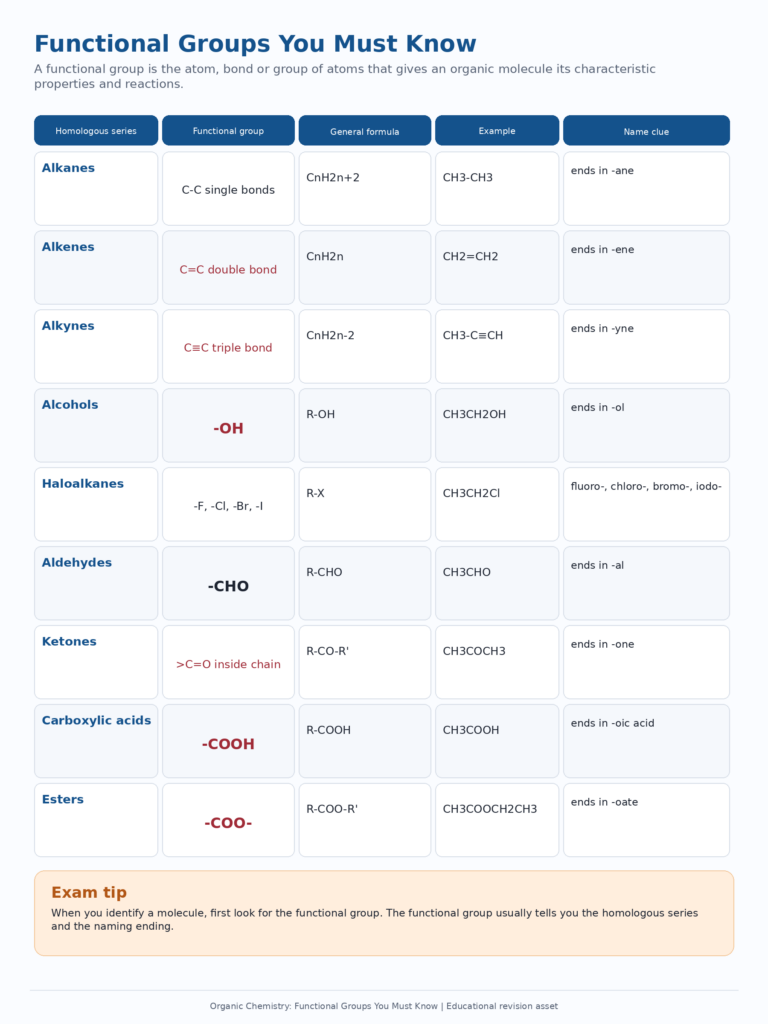
The main homologous series learners should know are:
- alkanes
- alkenes
- alkynes
- haloalkanes
- alcohols
- aldehydes
- ketones
- carboxylic acids
- esters
4. Alkanes
Alkanes are hydrocarbons that contain only single bonds between carbon atoms.
A hydrocarbon is a compound made up of hydrogen and carbon only.
Functional group
Alkanes do not have a special functional group like -OH or -COOH. They contain only carbon-carbon single bonds.
General formula
CnH2n+2
Name ending
Alkanes end in -ane.
Examples:
- methane
- ethane
- propane
- butane
Example structure
Ethane: CH3-CH3
What to remember
Alkanes are saturated hydrocarbons. This means they contain only single bonds between carbon atoms. They are less reactive than alkenes because there is no double bond to break open.
A common reaction of alkanes is substitution, where one hydrogen atom is replaced by another atom, usually a halogen such as chlorine or bromine.
5. Alkenes
Alkenes are hydrocarbons that contain at least one carbon-carbon double bond.
Functional group
C=C
General formula
CnH2n
Name ending
Alkenes end in -ene.
Examples:
- ethene
- propene
- butene
Example structure
Ethene: CH2=CH2
What to remember
Alkenes are unsaturated hydrocarbons because they contain a double bond. The double bond makes them more reactive than alkanes.
A common reaction of alkenes is addition. During addition, the double bond opens and atoms are added to the molecule.
Examples of addition reactions include:
- hydrogenation: hydrogen is added
- halogenation: a halogen is added
- hydrohalogenation: a hydrogen halide is added
- hydration: water is added
6. Alkynes
Alkynes are hydrocarbons that contain at least one carbon-carbon triple bond.
Functional group
C≡C
General formula
CnH2n-2
Name ending
Alkynes end in -yne.
Examples:
- ethyne
- propyne
- butyne
Example structure
Propyne: CH3-C≡CH
What to remember
Alkynes are also unsaturated hydrocarbons because they contain a multiple bond. In school exams, you should be able to identify the triple bond and recognise that the compound belongs to the alkyne homologous series.
7. Haloalkanes
Haloalkanes are organic compounds where one or more hydrogen atoms in an alkane have been replaced by a halogen.
The halogens commonly used in Organic Chemistry are:
- fluorine, F
- chlorine, Cl
- bromine, Br
- iodine, I
Functional group
-F, -Cl, -Br or -I
General formula
R-X
In this formula, R represents the carbon chain and X represents the halogen.
Name clue
Haloalkanes use prefixes such as:
- fluoro-
- chloro-
- bromo-
- iodo-
Examples:
- chloroethane
- 1-bromopropane
- 2-chlorobutane
Example structure
Chloroethane: CH3-CH2-Cl
What to remember
Haloalkanes are important because they often react through substitution or elimination.
In a substitution reaction, the halogen is replaced by another group.
In an elimination reaction, atoms are removed from the molecule and a double bond may form.
8. Alcohols
Alcohols contain a hydroxyl group.
Functional group
-OH
General formula
R-OH
Name ending
Alcohols end in -ol.
Examples:
- methanol
- ethanol
- propanol
- butanol
Example structure
Ethanol: CH3-CH2-OH
What to remember
The -OH group is called the hydroxyl group.
Do not confuse alcohols with bases just because they contain OH. In Organic Chemistry, the -OH group attached to a carbon chain shows that the compound is an alcohol.
Alcohols are important because they can take part in several reactions, including:
- elimination, where an alkene can form
- oxidation, where aldehydes, ketones or carboxylic acids can form
- esterification, where an ester forms when an alcohol reacts with a carboxylic acid
9. Aldehydes
Aldehydes contain a carbonyl group at the end of the carbon chain.
A carbonyl group is:
C=O
Functional group
-CHO
General formula
R-CHO
Name ending
Aldehydes end in -al.
Examples:
- methanal
- ethanal
- propanal
Example structure
Ethanal: CH3-CHO
What to remember
The important thing about aldehydes is that the C=O group is at the end of the chain.
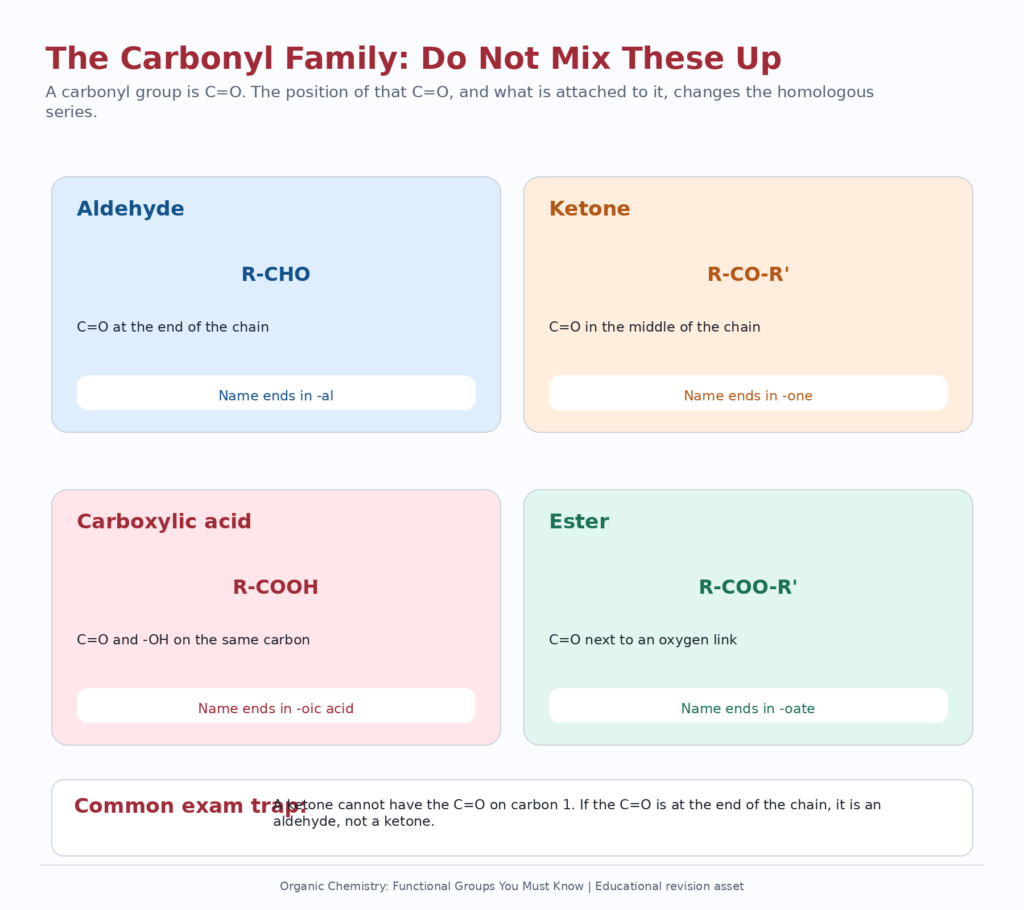
This is one of the most common exam traps. If the carbonyl group is at the end, the compound is an aldehyde. If it is inside the chain, it is a ketone.
10. Ketones
Ketones also contain a carbonyl group, but the C=O group is found inside the carbon chain.
Functional group
C=O inside the chain
General formula
R-CO-R’
Name ending
Ketones end in -one.
Examples:
- propanone
- butanone
- pentan-2-one
Example structure
Propanone: CH3-CO-CH3
What to remember
A ketone must have the carbonyl group between carbon atoms. This means the C=O cannot be on carbon 1 in a ketone.
If the C=O is on the first carbon, it is an aldehyde, not a ketone.
11. Carboxylic Acids
Carboxylic acids contain the carboxyl group.
Functional group
-COOH
General formula
R-COOH
Name ending
Carboxylic acids end in -oic acid.
Examples:
- methanoic acid
- ethanoic acid
- propanoic acid
Example structure
Ethanoic acid: CH3-COOH
What to remember
The -COOH group is made up of a carbonyl group and a hydroxyl group on the same carbon.
Carboxylic acids can react with alcohols to form esters. This reaction is called esterification.
12. Esters
Esters contain the ester link.
Functional group
-COO-
General formula
R-COO-R’
Name ending
Esters often end in -oate.
Examples:
- methyl ethanoate
- ethyl ethanoate
- propyl methanoate
Example structure
Ethyl ethanoate: CH3-COO-CH2-CH3
What to remember
Esters are formed when a carboxylic acid reacts with an alcohol. Water is also produced.
Carboxylic acid + alcohol → ester + water
Esters are often associated with fruity smells, which is why they are used in flavourings and perfumes.
13. How to Identify a Functional Group in an Exam
When you are given a structural formula, do not panic. Use a step-by-step method.
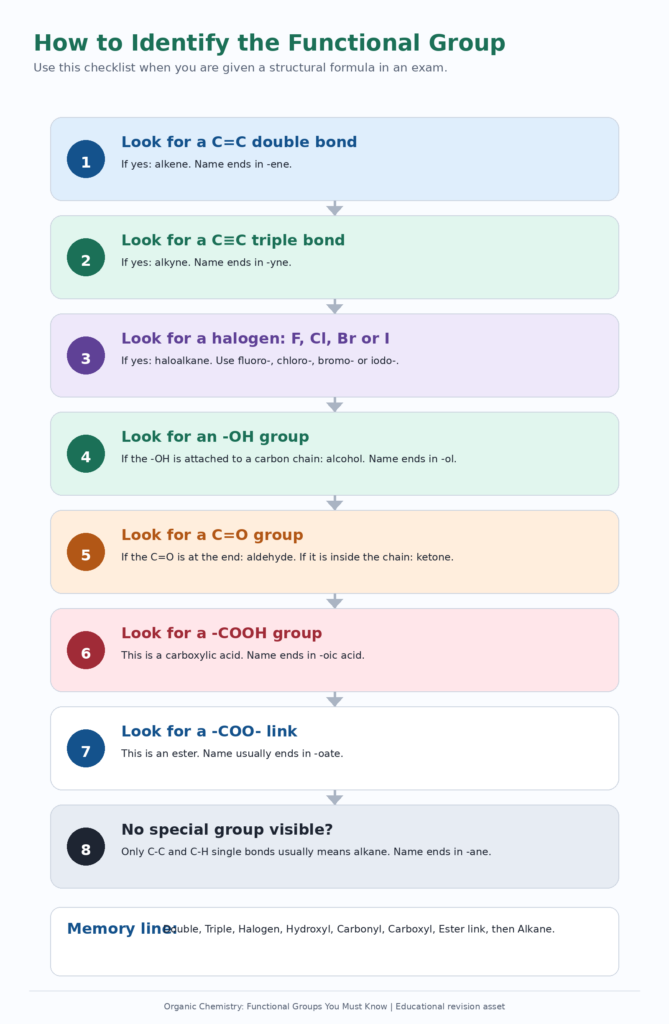
Step 1: Look for carbon-carbon multiple bonds
If you see C=C, the compound is an alkene.
If you see C≡C, the compound is an alkyne.
Step 2: Look for halogens
If you see F, Cl, Br or I attached to a carbon chain, the compound is a haloalkane.
Step 3: Look for -OH
If you see -OH attached to a carbon chain, the compound is an alcohol.
Step 4: Look for C=O
If the C=O is at the end of the chain, it is an aldehyde.
If the C=O is inside the chain, it is a ketone.
Step 5: Look for -COOH
If you see -COOH, the compound is a carboxylic acid.
Step 6: Look for -COO-
If you see -COO- between carbon groups, the compound is an ester.
Step 7: If there are only single bonds
If the molecule has only carbon and hydrogen with single bonds, it is probably an alkane.
14. Naming Organic Molecules: Basic Exam Method
Naming organic compounds becomes easier when you follow the same steps every time.
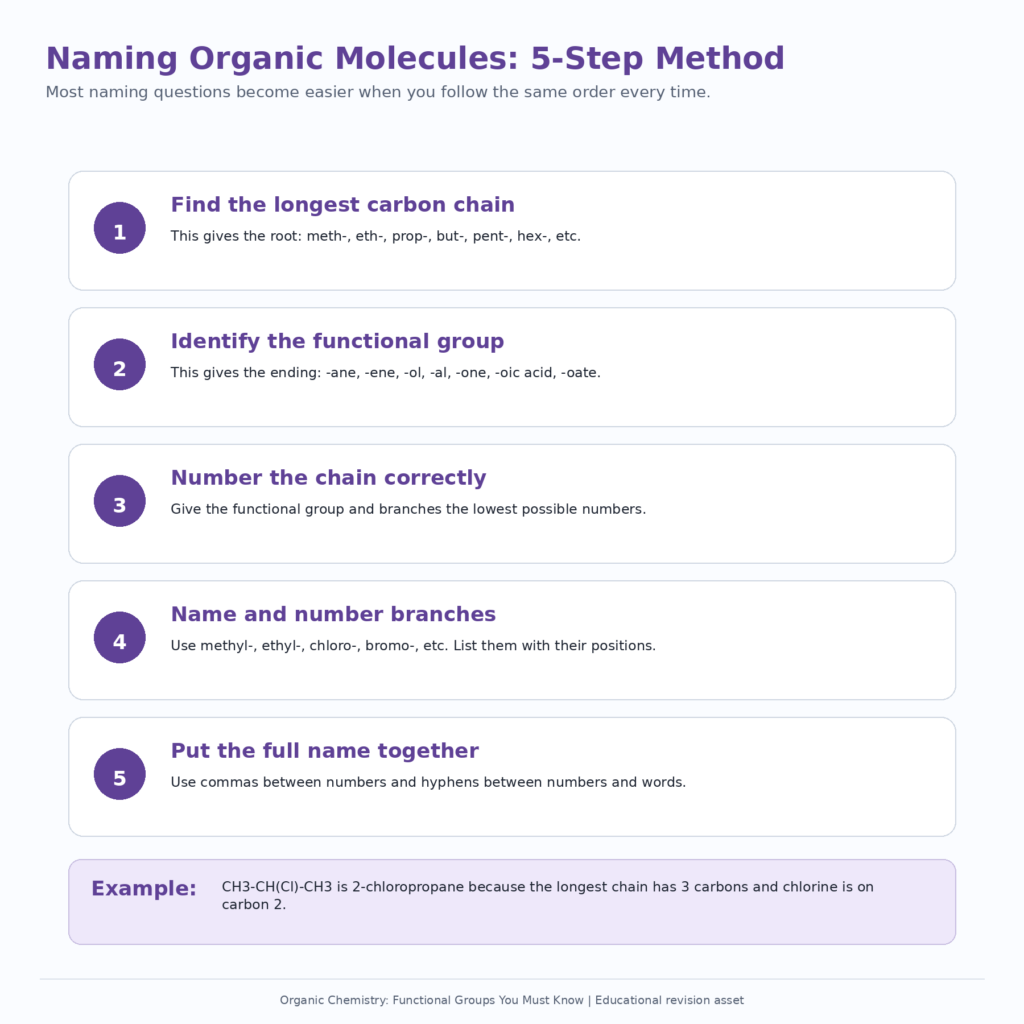
Step 1: Find the longest carbon chain
This gives the root name:
- 1 carbon: meth-
- 2 carbons: eth-
- 3 carbons: prop-
- 4 carbons: but-
- 5 carbons: pent-
- 6 carbons: hex-
Step 2: Identify the functional group
This tells you the ending of the name.
Examples:
- alkane: -ane
- alkene: -ene
- alkyne: -yne
- alcohol: -ol
- aldehyde: -al
- ketone: -one
- carboxylic acid: -oic acid
- ester: -oate
Step 3: Number the chain
Number the carbon chain so that the functional group gets the lowest possible number.
For example, but-1-ene and but-2-ene are different because the double bond is in a different position.
Step 4: Identify branches or substituents
Branches include groups such as:
- methyl-
- ethyl-
- chloro-
- bromo-
You must state where they are attached.
Example: 2-chloropropane
Step 5: Put the name together carefully
Use:
- commas between numbers
- hyphens between numbers and words
- correct suffix for the homologous series
15. Examples Learners Should Recognise
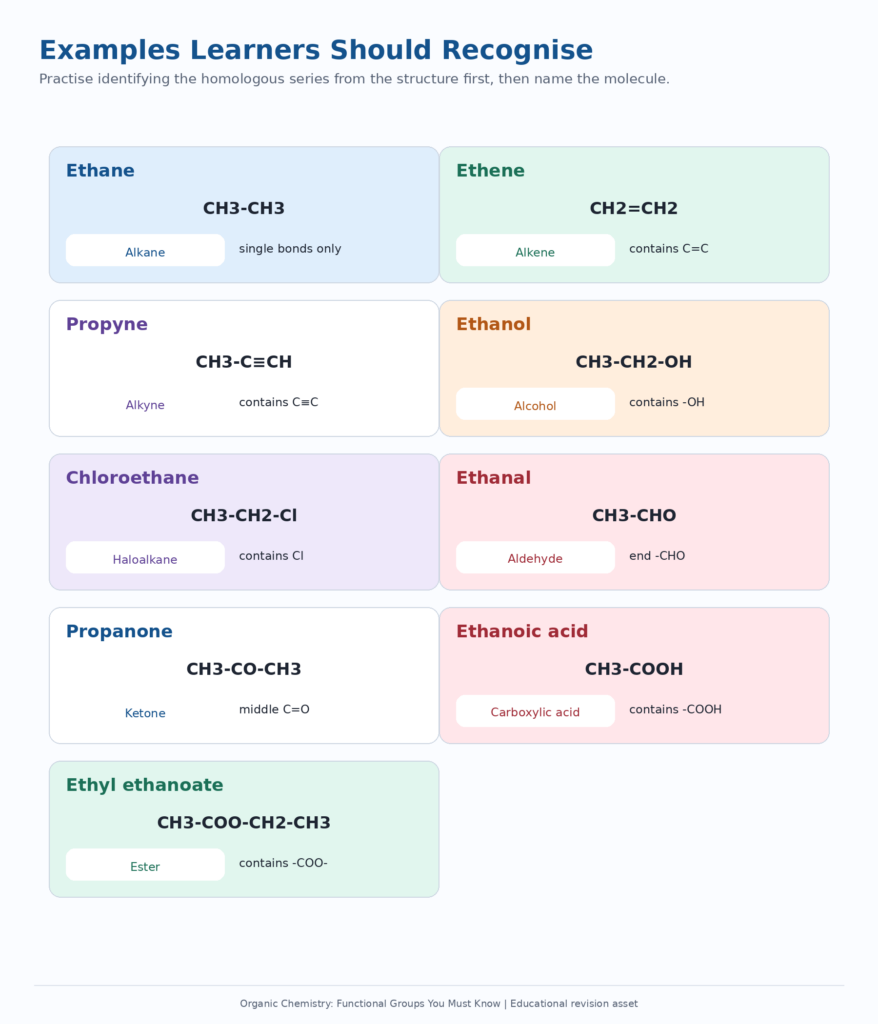
Here are some important examples:
| Formula | Name | Homologous series |
|---|---|---|
| CH3-CH3 | Ethane | Alkane |
| CH2=CH2 | Ethene | Alkene |
| CH3-C≡CH | Propyne | Alkyne |
| CH3-CH2-OH | Ethanol | Alcohol |
| CH3-CH2-Cl | Chloroethane | Haloalkane |
| CH3-CHO | Ethanal | Aldehyde |
| CH3-CO-CH3 | Propanone | Ketone |
| CH3-COOH | Ethanoic acid | Carboxylic acid |
| CH3-COO-CH2-CH3 | Ethyl ethanoate | Ester |
16. Functional Groups and Reactions
Functional groups help you predict reactions.
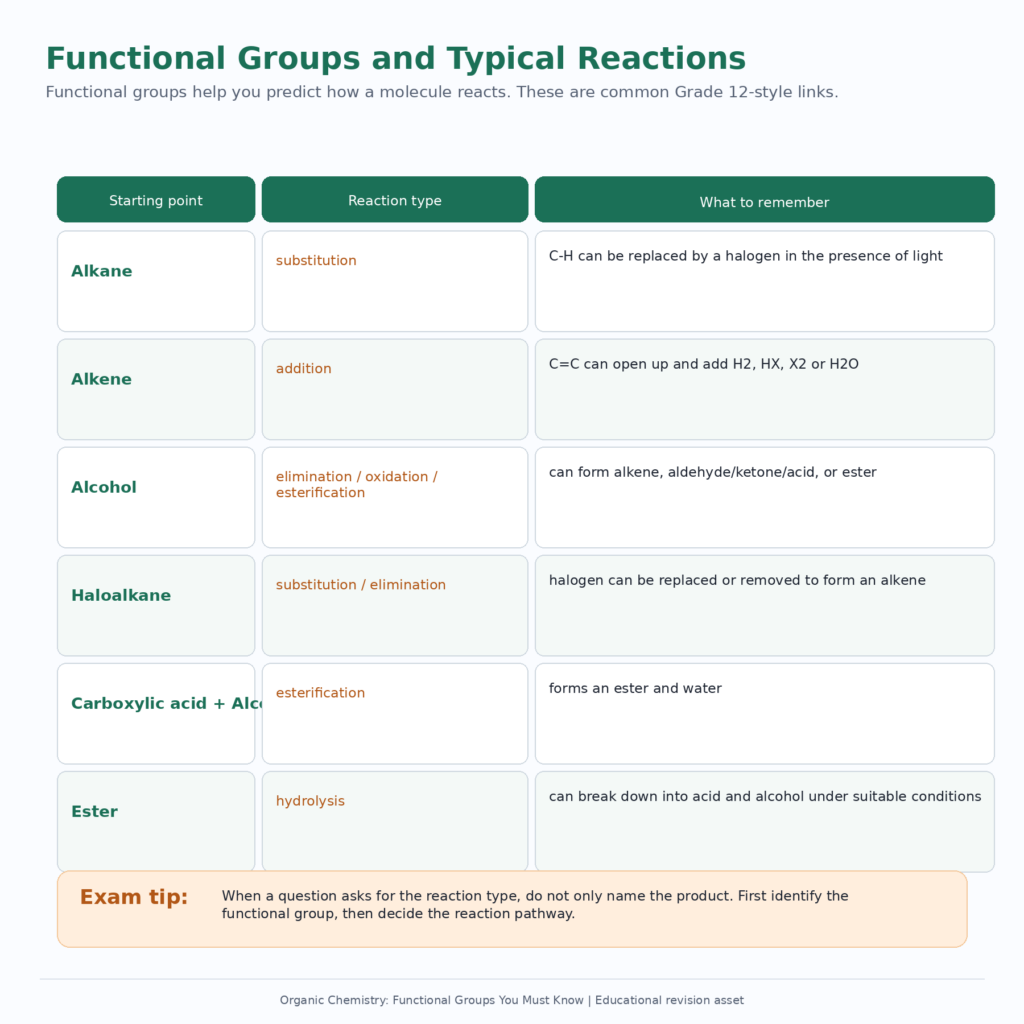
Alkanes
Alkanes usually undergo substitution reactions.
Example idea:
Hydrogen can be replaced by chlorine or bromine.
Alkenes
Alkenes undergo addition reactions because the double bond can open.
Examples:
- addition of hydrogen
- addition of bromine
- addition of water
- addition of hydrogen halides
Alcohols
Alcohols can undergo:
- elimination to form alkenes
- oxidation to form aldehydes, ketones or carboxylic acids
- esterification with carboxylic acids
Haloalkanes
Haloalkanes can undergo:
- substitution reactions
- elimination reactions
Carboxylic Acids and Alcohols
A carboxylic acid reacts with an alcohol to form an ester and water.
This is called esterification.
Esters
Esters can undergo hydrolysis, where the ester breaks down into an acid and an alcohol under suitable conditions.
17. Common Mistakes Learners Make
Mistake 1: Confusing aldehydes and ketones
Both contain C=O, but the position is different.
Aldehyde: C=O at the end
Ketone: C=O inside the chain
Mistake 2: Forgetting that alcohols end in -ol
If the molecule contains -OH, check whether it is an alcohol.
Mistake 3: Calling every oxygen-containing compound an alcohol
Not every compound with oxygen is an alcohol.
For example:
- carboxylic acids contain -COOH
- esters contain -COO-
- aldehydes contain -CHO
- ketones contain C=O
Mistake 4: Not numbering the chain correctly
The position of the functional group matters.
For example:
but-1-ene and but-2-ene are not the same.
Mistake 5: Ignoring the functional group when naming
Always identify the functional group before deciding the name ending.
18. Quick Revision Table
| Homologous series | Functional group | Name ending |
| Alkane | C-C single bonds only | -ane |
| Alkene | C=C | -ene |
| Alkyne | C≡C | -yne |
| Haloalkane | F, Cl, Br or I | fluoro-, chloro-, bromo-, iodo- |
| Alcohol | -OH | -ol |
| Aldehyde | -CHO | -al |
| Ketone | C=O inside chain | -one |
| Carboxylic acid | -COOH | -oic acid |
| Ester | -COO- | -oate |
19. Final Exam Tips
Before answering an Organic Chemistry question, ask yourself:
- How many carbon atoms are in the longest chain?
- Is there a functional group?
- Which homologous series does it belong to?
- What suffix should the name have?
- Do I need to number the position of the functional group?
- Are there any branches or halogens?
- Is the question asking for a name, formula, reaction type or product?
Organic Chemistry becomes much easier when you stop trying to memorise every molecule separately. Instead, learn the patterns. Functional groups are the key to those patterns.
Once you can recognise the functional group, you are already halfway to understanding the name, the reaction and the exam question.
Sign up for study resources
Get a one year free trial of our online study resources and bots. Sign up today.